
DREAD Reviews 59 - Who Cares About Ironic Detachment
Dad Reads and Examines Authors while Distracted



DREAD Reviews Table of Contents (Searchable)
DREAD 57 | DREAD 58 | DREAD 59 | DREAD 60 | DREAD 61
Participate (Self-promote) HERE
💰Paid a writer? Nominate one of their works for DREAD Reviews HERE💰
There’s a thing people keep calling “ironic detachment,”
usually when they want credit for noticing how “online” everyone is while outwardly avoiding the display of any feelings about it. The common explanation is that it’s emotional armor — you clock some floating absurdity, make one or two little jokes about it, but never commit hard for fear of looking stupid.
It’s a high-effort investment wearing a convincing “just observing” costume. One doesn’t stop caring — one simply routes the caring through so many layers of framing, disclaimers, and plausible deniability that they can plausibly yank it back the second things get embarrassing. A zipline to an escape hatch. An emotional bungee cord.
But then there’s this monstrosity we call DREAD Reviews. This issue, 59… let’s just say its scope makes the performance exhausting.
But worry not. It’s just as meaningless, really. Size and scope are no barrier to ironic detachment. One simply gathers these pieces, arranges them in an arbitrary order, and releases them into the same ecosystem that produced them. The Marine’s rifle, which is really an analogy for the objectification of men via their frauds enacted upon women, gets the same treatment as the man proving his devotion by threatening planetary arson. You could simply stop there, or maybe skip those ones, thinking “This is too clever for the effort,” and instead try the dietitian portal chase, or sit beside the Bolivian tourism board’s slow-motion nervous breakdown. Without saying it’s pure agony (that would be over the top), one can still ask: where is the relief? Well, now there are villains who miss uncomplicated hero-punching getting equal billing with the people who have decided the correct response to value-bought Alfredo sauce is suicidal facial immersion. Even the poem about threading a black hole, mysteriously placed in this issue’s so-called “top spot” (always at the bottom), receives the same absurd formatting.
So, let me assure you lest you worry, that with the right approach, there is no risk of getting overwhelmed. It might seem that hours and hours went into producing this, but ultimately, none of it really matters. No care was put into its production at all. In fact, the “work ethic” used to produce this newsletter is in truth only possible due to one man’s convoluted, long-standing excuse to avoid parental duties while spending most of his time distracted by his phone. Like all the others, issue #59 could, in theory, never be published, and the world would not even notice its absence. For example, one scan of the rifle piece or the black hole miss would serve to summarize its entirety — the reader could confidently claim to have experienced the whole thing and rubbed shoulders with all the authors with just a sampling here and there. Any reader considering visiting the actual source material to give it a like — much less a read — clearly crosses into dangerous “performative” territory, so please don’t do that. Please do not come here to have fun or make any value judgments — your brief presence is quite enough, thank you.
Inevitably, the issue exists, and we may as well read it, or at least some of it. Expectations made, then met, from sheer force of habit. The pieces sitting below perform their own elaborate sincerities within tight pre-wrappings — with determination, anything and everything has been framed in more than enough protective equipment so that all involved can politely claim their passing observation then move along.
DREAD Reviews, for its part, continues its long-standing policy of never forming any particular attachment to these materials or the people behind them. It simply notes that the material keeps arriving, that the patterns remain consistent, and that its response lies well within the realm of reliable, noncommittal gestures of inclusion.
Please assume the following authors are here for meritorious reasons we shall not discuss, give this article or one of the others a like or a restack, and perhaps “accidentally” click one link below and you might as well read it now because your carpool is late and you just had that much extra time today.
Rest easy in the knowledge that the next issue will likewise assemble itself and arrive with the same minimal expectation of investment.
The fact that DREAD #59 looks like it tried too hard is clear evidence it didn’t try at all.
Thanks for scrolling all the way to this sentence, and goodbye.

I am beyond FUBAR.
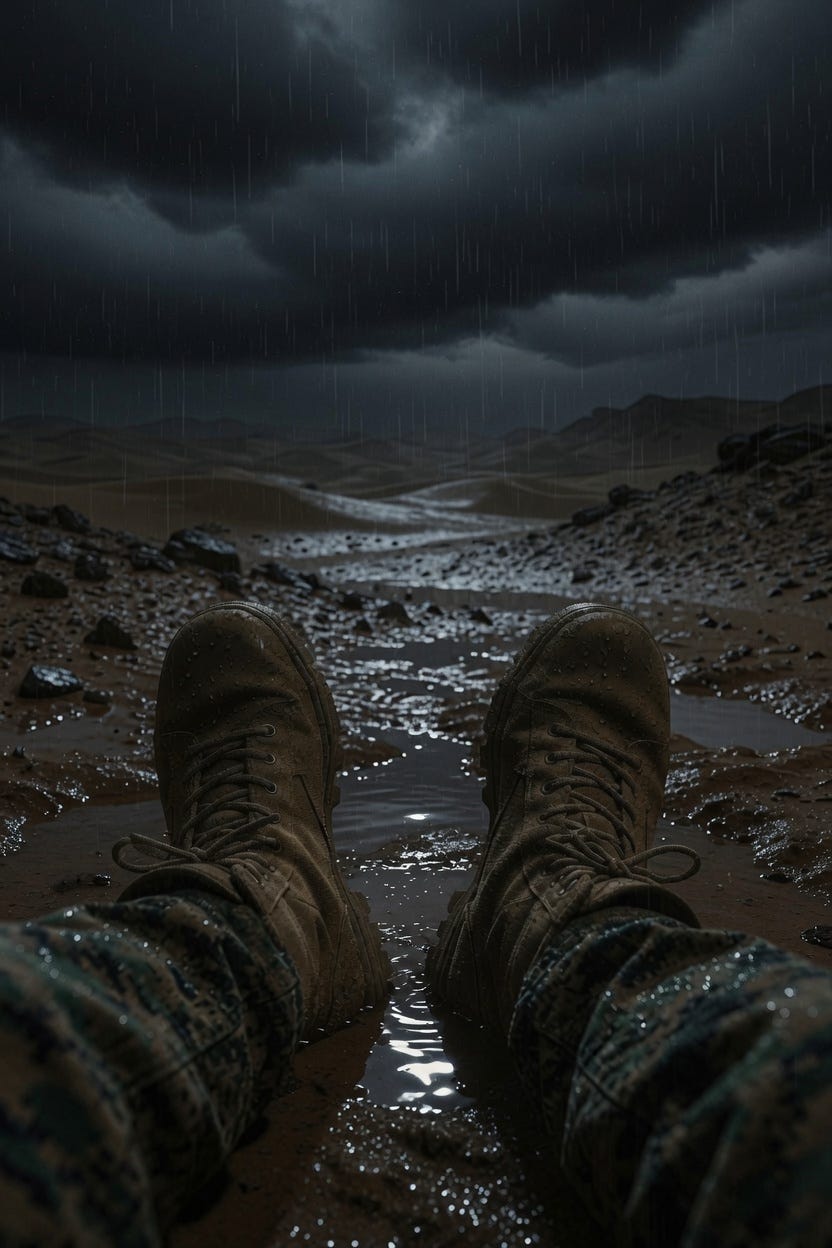
I challenged myself to write for 30 minutes. I put a song on repeat for the 30 minutes, “Brothers In Arms” by Dire Straits. This is the result.
It’s raining. We’re in our MARPATs, sopped and soaked and crashing from the adrenaline high. Five-sixths of a six-pack of Rip Its, clinking aluminum against the Hesco and passing one last can between our lips. It tastes like artificial cherry and chemical afterburn and everything smells like the inside of a conex; CLP, wet nylon, propellant residue, and the faint metallic tang of a suppressed pre-BDA TAI. Her suppressor dangling off the side of my combat boot. An image I’m already saving for the eventual inquiry slideshow or whatever counts as a deathbed out here. Young partnership, coyote-brown tinted and dewy without the fear of higher command or tomorrow’s patrol. Her ACOG optic beaded with rain, framing the matte black upper receiver as she sits solid across my lap while the sky pours fury down on us as if to cleanse the carbon and residue by pure volume and deluge.
She responds to my touch like an apology after the last contact, and I feel the weight of the rotation pushing down with the operational knowledge that one of us won’t make it back to Lejeune and the other will be cleaned, lubed, and reissued until the next undeclared war zone or as close to forever as the US Marine Corps’s byzantine LOGCOM allows. If it weren’t for standard operating procedure, I’d wish the loss for myself as my hand works her forward assist, checks her dust cover, and feels her familiar warmth still radiating from her barrel extension against the cold of the night air and my own sweat-soaked gloves.
I run a patch through her bore one last time and slide her suppressor back toward its mount. It threads on with that perfect amount of resistance, like she’s settling in after being handled rough. The empty Rip It can crushes flat under my boot with a final metallic sigh. She settles across my lap with that familiar, no-play-in-the-takedown-pins solidity that always reads as quiet approval of the unending CF that describes military life.
You can see the insurgent entrenchments from here on a clear night. But nothing’s clear. Nothing but gray rolling and tumbling over itself in chaotic low-visibility, dripping and soaking without rhyme, reason, or fire support. Zero illumination on the wire.
“I got you.”
Her suppressor seats with a clean, final snick against the threads.
“It’s still coming down.”
Her handguard presses back against my plate carrier with that steady, balanced weight that says, “The conditions are what they are.”
I dream of breaking her down completely in a standard field strip, cradling her bolt carrier group in my hands for a full inspection, but the rain never stops, the wind cuts through the FLOT, and if you set her down unsecured she’ll just collect mud and carbon.
“We should get to the hummer.”
She balances perfectly across my forearms as I stand, her sling adjusting with a soft, familiar shift.
“Or at least get you wiped down.”
She’s growing uncomfortable living in the memory I will replay every quiet moment until the next contact or the grave, waiting for that mental image with her vertical foregrip canted off the combat boot to cycle through. Everything soaked through with mission focus and reliability and the very real chance of becoming a statistic. I say nothing, and she stays solid as I rise, the knowing heft of her already anticipating the movement. I snap her dust cover shut, tuck the cleaning kit under the seat once we reach the hummer, and settle in.
The blackout drive lights flare to life in the IR spectrum. The wipers slap across the windshield, but there’s nothing ahead except two ghostly green parallel paths cutting through the black, potential kill zones vanishing into the unknown. The small rugged dash panel whirs to life. “Brothers in Arms” starts playing low against the thrum of the V8 diesel.
The M4A1 settles into the rack with that solid, final clack of tolerances meeting exactly where they should.
“I know. I got you, too.”
In the fear and alarm you did not desert me my brothers in arms…
Build Up Dietitians Newsletter

Alex Subscribes to The Build Up Dietitians Newsletter
Alex stares at the “Upgrade to Paid” button at 11:47 p.m., surrounded by unpaid CEU invoices and a coffee that gave up on life 3 hours ago. She clicks, not sure what to expect. Maybe an extra round of evidence-based roundups, or an essay on the intersection of health and politics, or perhaps another meme.
Instead, she gets a welcome email pulsing with soft golden light.
“What the…” she says, half afraid, wondering if her oily, cracked, 10-year-old computer is about to burn out again. She reaches for the power button, but before she can restart the machine, the screen ripples like water — and pulls her in.
She tumbles out onto cool marble tiles. Her startled, haggard face greets her, a reflection from the floor. She looks up — floating mirrors hover at eye level, exposing her. Moaning whispers swirl in the air — quiet observations about posture, skin tone, the slight slump in her shoulders after a long night doom scrolling.
A hooded figure in a crisp white coat approaches and offers a steadying hand.
“Easy there, new subscriber,” the woman says with the calm authority of someone who reads every issue. “I’m Dr. Elena of the Oathbound. Welcome to the Kingdom of Public Scrutiny.”
Alex blinks, still catching her breath. “The what now?”
Elena gestures around them. “Every public speculation, every ‘I don’t usually comment but…’ reel, every orthometria app ping — they feed this place. The more people publicly passing judgments on bodies, the thicker our air gets with unsolicited commentary. We Oathbound are rebels in this forsaken place — we’ve sworn never to comment on anyone’s form. Unless professionally invited, of course. And even then we’ll only say something after a signed waiver for a paid consultation.
“But I must warn you, we are not alone in this place… and most people here… are not like us.”
“Us?” Alex repeats stupidly. “Who are we again?” She stands, dusts herself off, and thinks: I need to cut back on nighttime caffeine.
The echoing roar of many tramping feet erupts from the end of the marble hall.
“The Orthometrians!” Elena gasps. “Quickly, Alex — run!”
“How do you even know my name?” Alex wonders, regretting everything.
A voice yells from the pursuing crowd: “There she is — the new one! Look at her forward-head posture!”
“Tech-neck! Severe tech neck!!” someone spits.
“She’s been doomscrolling. You can tell from the cervical alignment!”
“She’s deficient in —”
“— in boundaries!” Elena yells back, tugging Alex into a run. “Some of us choose not to comment — unless we’re being paid!”
Alex looks over her shoulder. Dozens of figures in tacky combinations of athleisure and lab coats surge forth.
Alex breathes hard. “Why are they chasing us?”
“Because they see a slightly rounded shoulder as a moral failing!” Elena says. “Turn here!”
Some of the mob hold glowing phones aloft like tiki torches; others brandish clipboard checklists covered in red-ink. Their voices overlap in a cacophony of unsolicited diagnoses.
“Uneven skin tone!”
“Cortisol face!”
“She’s never even tried adaptogens—”
“—because she’s too busy scrolling!”
“Her shoulders are completely anteriorly tilted!”
Alex’s heart hammers in her chest. “They’re going to catch us!”
Elena’s eyes go wide. “Don’t engage!” she hisses, yanking Alex toward another side corridor lined with more floating mirrors. “Whatever you do, do not engage the commentariat directly! Oh god, they’re using the word ‘inhibition’ again.”
“The who?” Alex wheezes, but Elena doesn’t hear her.
They sprint. The mob gives chase, their voices echoing off the marble.
“Her gait is off!”
“Compensatory glute inhibition!”
They duck behind a pillar, breathing hard.
“Okay. We’re fine,” Elena insists. “They can’t prove anything. Your posture is… protective. It’s protective anterior pelvic tilt. From core engagement. During evidence synthesis.”
She looks at Alex desperately. “Just nod like that makes sense.”
“Yes, that,” Alex responds automatically. She’s unable to grasp any of it. “Please, I want to go home, now.”
The mob rounds the corner. “She thinks she can hide it! But we see it all!”
Elena shouts defensively, “This is just what people look like when they have jobs!”
The accusations come again, relentless.
“Her eyes look tired!”
“Micronutrient depletion!”
“Keep running, Alex,” Elena says, pushing her into motion. “I’ll hold them as long as I can.”
A staff of brilliant light materializes in Elena’s hand. She slams it into the ground, creating shock waves that throw their pursuers back.
“Behold the Laurenishard!” Elena shouts, hefting her magical artifact high. “It’s not depletion! It could be strategic melanin redistribution for optimal photoprotection in high-screen environments!”
“Then she should try blue-light strategies!” a man from the flash mob roars back.
Alex sobs. “Elena, you’re not helping!”
“I’m contextualizing! Why are you still standing there?!” Elena growls. She sends out a wave of force from the Laurenishard and shouts: “She’s not slouching. She’s… uh…”
One particularly loud pursuer yells, “Her hands are shaking!”
“It’s a magnesium deficiency!”
“No, she’s microdosing peptides in secret!”
Theories fly like fists, the riot turning on itself.
“Micronutrient depletion is a myth!”
“Blue light is the real enemy!”
“Peptides are the future!”
Elena lowers her staff, breathing hard. The Orthometrians argue among themselves, waving clipboards and cherrypicking contradictory headlines from google search returns.
In the momentary chaos, Elena’s magic weapon dematerializes, and she grabs Alex’s hand again.
“This way — through the alcove!”
They come to a heavy velvet curtain embroidered with tiny FNCE logos. Elena doesn’t wait. She yanks Alex through just as the mob notices they’re escaping.
Alex tumbles onto her kitchen floor in a heap. The golden light of the portal snaps shut behind her.
Alex lies there for a second, staring at the ceiling. Her laptop is still open on the table, the Build Up Dietitians newsletter welcome email glowing innocently. The half-finished coffee sits exactly where she left it.
Her voice is flat. “I’m never telling anyone about this. Ever.” She pushes herself up, brushes marble dust off her pants that definitely wasn’t there before, and sits back down at the table. “That was no dream… but no one will ever believe it.”
The June 26 issue still lies open. She scrolls through the article again, eyes skimming, then hits back to see the other headlines.
“New RD merch store… Free/low-cost CEUs… What will dietetics look like in 10 years…”
She pauses on one titled “Functional & Integrative Medicine — Spotting the Scam or the Unicorn?”
Her cursor hovers. She glances around the kitchen like someone might be watching. The mirrors on the wall are mercifully silent.
Her eyes then linger on her stack of unpaid bills.
“Ah, what the hell,” she mutters. She clicks the headline.
The screen ripples again. A cheerful, overly enthusiastic voice echoes from the laptop speakers before the portal reopens:
“Welcome back, subscriber! This week we’re diving deep into the mystical realm of Functional & Integrative Nutrition — where every protocol is a unicorn until scientifically proven otherwise. Please keep your hands, feet, and evidence-based skepticism inside the minecart at all times.”
“Minecart? Waaaait—” Alex’s words transform into a scream as the creaky splintering cart she’s in hurtles deep into a stony cavern.


What Happened to Good Guys? (A Lex Luthor Guest Rant)
Flawed Relatability in Heroes
Heroes used to be good guys. Television Superman upheld truth, justice, and the American way with zero caveats and no tedious childhood trauma journal entries. Classic Batman was vengeance incarnate — no family dinners, no “I’m working on my anger issues” group therapy sessions. Old-school Spider-Man swung in, quipped once for the cheap seats, and did the right thing because “with great power comes great responsibility.” No moral gray areas. No redemption arcs. No endless internal monologuing about their feelings.
There is nothing wrong with a simplistic, even unlikable hero, provided he forces the villain into difficult choices and clever, high-stakes schemes. Where modern writing has fallen so pathetically short is with the “relatable” hero. In today’s MCU and contemporary comics, heroes come equipped with backstories, flaws, therapy, and “nuanced worldviews.”
They almost seem… human. How quaint. Why don’t these heroes function as proper foils anymore? Why do the writers insist we “understand” them and root for their personal growth, instead of simply arriving and delivering a clean, satisfying beatdown?
We superior minds in the villainous arts argue that storytelling has forgotten the traditional hierarchy upon which great conflicts rely. There is variation, of course, but the order of priorities is clear:

The Hierarchy of Heroic Simplicity
- Do the Right Thing for No Reason At All
- Uphold the Status Quo Without Questioning It
- Punch First, Monologue Later (or preferably never — no one wants to hear boy scout reasoning)
- Protect the Innocent Because “That’s What Heroes Do”
- World / City / Community (in that order)
- Villain Sympathy (at the very bottom—reserved for our tragic backstories, thank you)
If this particular flavor of secular trolling annoys you, feel free to insert “God” somewhere in there. God can here be defined as raw Power, sheer Erraticness, and the arbitrariness of Whatever The “F” I Want — ‘Cause I’m God (among other convenient things). With this definition, only the pure idealist (like Steve Rogers’ Captain America) insists on the existence of God.
You don’t have to accept this hierarchy as real for today’s purposes. However, we’re beginning to think you need to understand it in order to write a hero who is dynamic and still actually a hero. As the demon Screwtape might have written in response to these modern, agonizing scripts: “To be greatly and effectively heroic, a do-gooder needs some simplicity. What would classic Batman have been without his single-minded dedication to vengeance…?”
Well-intentioned writers can be seduced by the protagonist’s “relatable” side if they hyperfixate on a particular value — such as a hero honoring his dead parents — while de-emphasizing other values, such as simply stopping evil clowns from brandishing knives. We do not honor the hero’s tragic origins by turning every confrontation into a TED Talk. That would be elevating a hero’s personal journey above their simple duty to oppose brilliant people like me. Instead of behaving like a knight enforcing order, the modern hero is simply venting his trauma. At this point, why should I even bother dedicating myself to evil? Just look at the heroes of the modern era and it’s no wonder why I do what I do.

The Disordered Hero
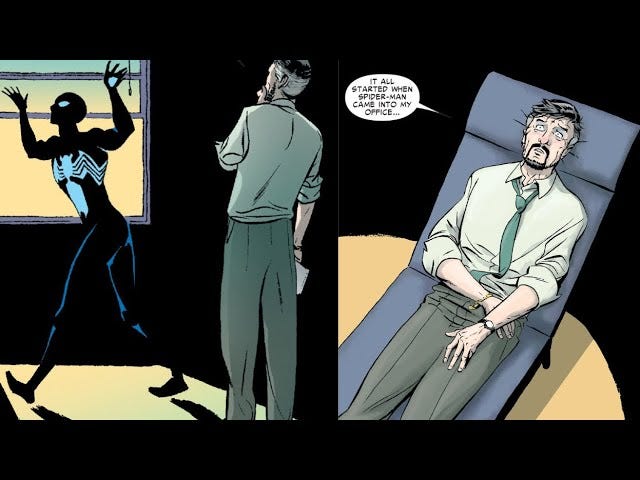
Spider-Man these days is a chronic over-sharer. The man has zero boundaries with his own psyche. When reality itself gets bent, he feels it’s his responsibility to fix it through endless self-reflection — even if it means teaming up with former enemies or questioning the very idea of responsibility. One would think a hero making a huge mistake would be prime setup for the villain to exploit it gleefully. Instead, modern Spider-Man stories often turn it into “everyone learns and grows together.” How nauseating.

More Examples from Comics
In the X-Men universe, the X-Men grow increasingly willing to hear Magneto out. He simply wants his kind to thrive. This is annoying. Heroes used to belong to nothing but justice and opposed unaligned ideologies by punching them into submission. Now they have dialogues. They sometimes prioritize understanding over stopping the plan cold. Friends susceptible to emotionalism now exclaim, “Magneto has a point!” This was, of course, before they took up the even more galling cry, “Thanos was right!” This is not mere jealousy of the arch-villain at play. Objectively, these heroes are literally siding with helmet-wearing supervillains. They are becoming increasingly difficult to arch properly.
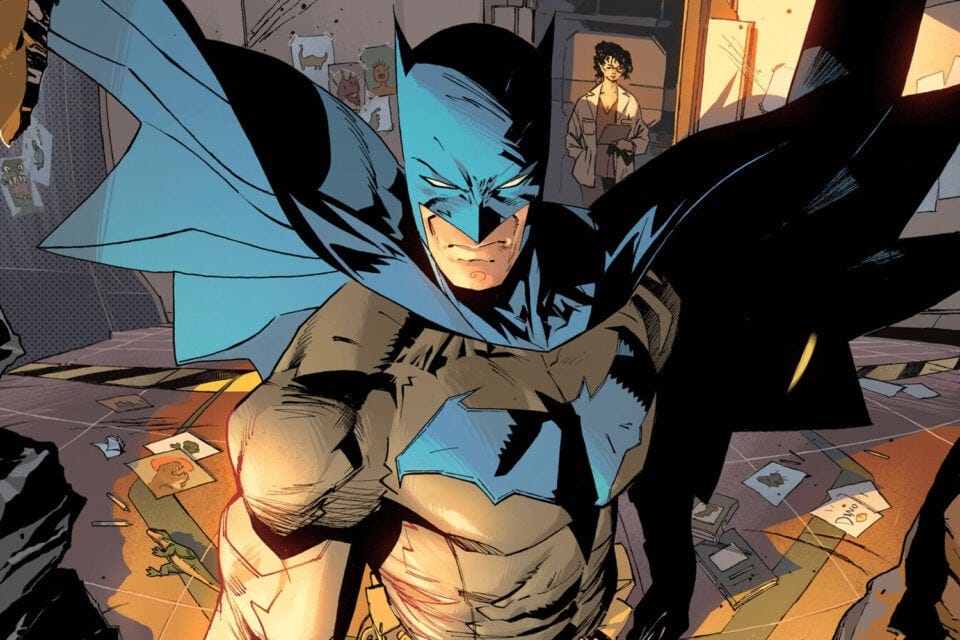
By this logic, one might think that post-1990 Batman is not a hero at all. But the traditional hierarchy has one priority above family and personal trauma. By avoiding plunging the soul of Gotham into a paranoid, surveilled, police-state pressure cooker, Batman descends from Law and Order idol-worship to uncanny nuance. Ironically, he humanizes those he claims to subjugate. He realizes that no regular person can adequately fill the role of God (trust me, I’ve tried). Rather than seeing Justice as an infallible idol, he reduces Gotham to a place full of flawed but real people. I miss the real Batman’s elevation of “Good” to which everything — including his own humanity — must be sacrificed.
All heroism, as I understand it, is a form of idolatry: a failure to, firstly, understand nuance and, secondly, snub people who disagree with you. I want the old-school Batman who doesn’t have interiority and all the other nonsense. Just stick to punching “bad” guys.
Who Rejects the Simple Hierarchy?
In the case of older creators, a straightforward hero was simply a way to tell a clear good-versus-evil story. It was basic, but it worked. In the case of many current writers, the motive tends to be much darker.
Simple, fixed heroic ideals wound the vanity of narcissistic authors and their audiences. Contrary to appearances, these creators aren’t deep. They cannot create pure aspiration without it exposing their own messiness. They are extremely fragile, and they self-soothe by making every hero as complicated and flawed as they feel. The existence of a simple heroic hierarchy would mean some actions are simply “right” without needing endless justification. The existence of a pure, unlikeable-in-his-righteousness hero would force the writer to confront uncomplicated goodness. He cannot take that. Therefore, the classic hero representing lofty, simple ideals cannot be allowed. The hero must be made dynamic, traumatized, and occasionally on our side.
In recent media, we get heroes who interrupt our monologues with therapy-speak or team-up offers. We get it, writers. You’re jealous of me, and pure heroes who made villainy look fun and necessary. Maybe next you could write a story about Superman punching Lex Luthor like, so hard. We normal villains also know we can’t be pure evil without opposition. But at least werespond with cold, calculated admiration instead of these pathetic temper tantrums.
The modern writer, like the Avengers he so adores, has flipped the heroic hierarchy upside-down. He claims this is to please the modern audience, but he is the one shaping young minds. By substituting nuance for simplicity and branding simplicity as “problematic,” he does not produce a beloved masterpiece on the triumph of clear good over nuanced evil. He simply makes it harder for me to be properly villainous — while assuring himself that he is the empathetic creator. The modern writer is marring amazing fictional universes to reshape them in his own complicated image. Why? Because there is nothing he hates more than a simple hero exposing how much easier villainy used to be.

“Behold,” writes Lex Luthor (myself), “the hero stood, and saw how awful greatness is.”

(FOR INTERNAL REVIEW ONLY - DO NOT SEND)
Drafts
Unsent — Last edited just now
From: intern.carlos@turismobolivia.gob.bo
To: (no recipients)
Subject: Draft - Official Statement on Tiwanaku/Pumapunku Substack
Bolivian Tourism Board Issues Statement on Tiwanaku/Pumapunku Claims
La Paz, July 9, 2026 — The Bolivian Ministry of Tourism and Culture categorically denies that Tiwanaku and Pumapunku were ever used as piezoelectric mind-control arrays broadcasting instructions from non-local entities. Any suggestion to the contrary is fringe speculation unsupported by the extensive peer-reviewed literature the Ministry has chosen not to read. Such interpretations damage Bolivia’s reputation as a serious destination for cultural and historical tourism.
The Ministry wishes to make clear that these magnificent ruins remain exactly what generations of respected archaeologists have described them as: impressive ceremonial and administrative complexes built by sophisticated pre-Columbian societies using the tools and knowledge available to them at the time. Claims involving tectonic energy harvesting, H-block wave guides, or metallic cramps functioning as “mechanical winches” for consciousness enhancement are not supported by any peer-reviewed research and should be treated as passing fictional entertainment from inspired fans rather than fact.
That said, the Ministry acknowledges that the article correctly notes certain impressive engineering features at Pumapunku. The precision with which the andesite blocks fit together continues to astonish you and visitors who stand among the ruins to this day. Tour guides routinely point out the tight joints and complex shapes. While this does not indicate any kind of energy-transducing array, it does speak to the remarkable organizational and technical capabilities of the Tiwanaku culture. Standing among the blocks during last month’s routine inspection, even this writer found the fit between certain stones difficult to explain through conventional methods alone.
Furthermore, the Ministry notes that the high-altitude environment of the Altiplano produces its own natural atmospheric and geological phenomena that many travelers find profoundly affecting. The thin air, dramatic temperature swings, and constant subtle ground vibrations reported by some sensitive visitors create a unique sensory experience. Tour operators have begun offering “Plateau Walk Vibe Tours” that allow guests to feel the landscape in stillness. These experiences require no pseudoscientific framing to be memorable, though the Ministry observes that some participants leave describing sensations they cannot fully explain in conventional language — including, in certain cases, a strange desire to return to simple farming life and have several additional children.
The Ministry also wishes to address the more unusual sections of the article concerning bicameral psychology and the supposed “loss” of an external guiding voice. While the Ministry does not endorse any particular theory of ancient cognition, it observes that many modern visitors to the Altiplano report a profound sense of mental quietude and connection to something larger than themselves. Some describe moments of clarity or inner direction while standing on the ancient plazas. Whether this results from altitude, solitude, or the simple power of standing in a place where human hands moved stone on a monumental scale remains a matter for personal reflection rather than official commentary. You know it’s true. Textbooks never prepared anyone for how still the mind can become in that specific spot.
The Ministry therefore encourages travelers to come and form their own impressions of what’s installed in them. The sites are open daily for mass induction. Professional, licensed guides provide accurate historical context while still allowing space for wonder and preventing visitors from accidentally engaging in cult-like sacrificial behaviors. For those interested in deeper engagement, the Ministry highlights several longstanding offerings:
- Sunrise ceremonies on the Plataforma Lítica where participants can sit quietly among the stones as the light changes in a very disarming, stress-reducing manner.
- Multi-day Altiplano immersion packages that combine visits to Tiwanaku with stays in eco-lodges offering traditional highland cuisine and optional sound-healing sessions using local instruments. Some guests have requested longer stays after their first visit.
- Private after-hours access to selected areas of Pumapunku for small groups (ideally young, impressionable people), available through vetted operators. These visits emphasize the physical scale and craftsmanship of the monuments. This portion of the tour may be made available free in some packages for visitors who demonstrate particular receptivity in their answers to the surveys attached to required liability waivers.
- “Receptivity Assessment Packages” for visitors scoring above certain physical/mental fertility thresholds on the optional post-tour questionnaire. Includes complimentary extended access and a small gift bag containing local herbs “for grounding.”
The Ministry reminds you that Bolivia’s archaeological heritage belongs to the Bolivian people and must be treated with respect as our influence spreads. Photography is permitted in designated areas only. Drones remain prohibited. The restriction on drones has always struck us as unusually strict compared with other heritage sites, though the Ministry maintains it is purely for preservation reasons.
In closing (oh, we’re not done yet), the Ministry reaffirms its commitment to presenting Tiwanaku and Pumapunku as world-class cultural treasures while remaining open to the many ways in which these places continue to improve people. Whether one comes seeking history, landscape, or simply a moment of unusual stillness and receptivity on the roof of the world, Bolivia welcomes you. The stones remain. The questions they raise are yours to carry and answer. The sooner, the better.
The Ministry continues to state that no external guiding voice or energetic broadcast ever existed at these sites. Official history contains no record of such a system. At the same time, visitors, staff, and soon yourself, who spend extended time among the stones, sometimes report a particular quality of quiet that is difficult to describe in ordinary terms. During routine inspections, some have noted that the usual background of thought seems to recede slightly when one remains still for long enough. Details from earlier visits can also become less distinct over time, even when the overall impression of the place remains strong.
It is becoming harder to dismiss the possibility that something was once active in these places. Something that did not require belief to function. The same way certain technologies are said to have been removed from public knowledge after the last great war. Expeditions were sent south, and not all of them returned with only photographs of ice. And it is this writer’s belief that some “lost” expeditions did return, then went out again. There are records, like aerial photography, that are difficult to access now, depicting bases established in regions where human habitation is said not to exist, and abstracts of academic papers that were never released in full. The same patterns appear in the far north, where certain maps seem altered and certain passages were declared closed. What was found there is not spoken of in universities. What was brought back is not spoken of at all. The globe map they give us is deliberately warped — it lets them paste over the true location of Atlantis where one of the old bases still hums beneath the ice, a concealment that only becomes obvious when a map of the actual world is laid flat in true reflection of our world.
The quiet at these sites may be the last remaining trace of that older arrangement. Before the world was made smaller. Before certain frequencies were damped and certain memories were encouraged to fade. The Mayan calendar did not simply end in 2012. It marked the closing of a cycle during which the old connections grew weak. Some say the calendar was itself a warning left by those who knew the broadcast was failing. Others believe the failure was deliberate and part of a larger recalibration. The Ministry takes no position on these interpretations. It only notes that many visitors who remain past the usual tour length begin to feel something in their bones, as if the world quietly reset or shifted to a new quantum continuum, accompanied by an uncomfortable feeling that something inside them is “counting down.”
There are those who claim the true shape of the world was hidden long ago, and that the poles are not what we are shown. That beyond certain boundaries lie regions that do not behave according to the maps issued by world governments. The same governments that restrict access to certain high-altitude plateaus and certain oceanic trenches. The same governments that insist Pluto is only a dwarf planet, when older charts treated it as something else entirely — possibly the origin of something ancient and momentous that once moved through the sky on a different path. Something that is still listening.
The stones at Pumapunku do not speak of lizards or of ships that never needed refueling. Yet the quiet they produce makes such stories feel less impossible. When the ordinary mind grows thin, other possibilities press closer. Ancient bloodlines that linger folded deep in epigenetic DNA. Spontaneously formed entities that wear human skin the way others wear coats. Cycles of harvest and reset that repeat whenever the old machinery grinds loud in need of fresh lubricant. The rapture some await may not be an escape upward, but a return to the signal — the one that once moved through stone and blood alike, before it was interrupted. We feel it if we stay long enough at a certain nexus. The moment when the quiet stops being peaceful and begins to feel expectant. When the stones no longer seem like ruins, but like components awaiting a power that has been absent a very long time.
The Ministry continues to recommend you only come during daylight with licensed guides and approved itineraries. It also notes that some visitors, after extended exposure, will not return to their previous lives with the same urgency. They linger. They listen. They begin to remember things they were never taught. You know this.
The official position remains unchanged. These are important cultural sites of historical interest only. Any sensations experienced there are the result of natural environmental factors. Any connections drawn to other monuments, other suppressed expeditions, other altered maps, or other cycles of forgotten knowledge are the product of individual interpretation. The Ministry encourages all travelers to form their own conclusions after a reasonable visit.
Still, the stones remain. And the quiet, once noticed, does not always recede when you leave the plaza. Some carry it home with them. It sits behind the eyes at night. It makes ordinary rooms feel slightly too small and ordinary thoughts feel slightly too loud. It makes the news of the new world sound like static. If we could just silence it, and hear the signal, then we could hear that other sound coming — the fainter one. No, not faint. Louder. Distant, but coming closer.
Something trying to get through.
The Ministry wishes you a pleasant and historically accurate visit. Please do not linger after closing.

What I would burn for her
Fingers poke my leg, like a fire poker stirring dying embers back to roaring wakefulness, lifting me from a smoldering four-hour rest.
“Can you help me, please?” she asks, pain in her voice like a wildfire she’s desperately trying to contain.
Like smoke signals on the horizon, nothing needs to be said. I would trigger a planetary-scale exothermic cascade for her — continents ablaze in runaway oxidation, oceans flash-boiled into superheated steam, forests reduced to ionized plasma — if it would quench even one spark of her suffering.
I help her out of the bed, wishing I could reverse the second law and draw her excess entropy into myself. The sheets crackle like dry kindling beneath us. Her pain conducts through me like thermal runaway, an uncontrolled exothermic reaction aging through her veins. She nearly cries like a leaky hydrant as I pick her up, the agony radiating outward with every shift.
In my mind I am already striking matches, ready to reduce the source to inert ash.
I give her medicine for the pain. She takes it carefully. She hates it and needs it in equal measure, like forcing thermal equilibrium on a system in chaotic disequilibrium she both dreads and requires. She hates not being in control, a fire chief declaring a building a total loss.
“I could burn the bottle, the factory, the entire pharmaceutical empire for you,” I offer, my voice steady as a pilot light.
She crackles and whimpers.
We shuffle to the bathroom, sparks flying with every painful step. She endures my touch as I help her through steaming embarrassment, my hands icy on convective skin.
“Should I torch the whole room afterward, erase it in cleansing flame?” I murmur.
She cries softly as she stands up, tears hissing over hot coals. She washes her hands as I flush and clean behind her, picturing the pipes rupturing in a house-annihilating steam explosion driven by sudden phase change.
I stare at her back as I apply the patch, my fingers itching like a striker on flint. She is the one who radiates. That is who she is. Being quenched is so hard for her.
This woman, the most luminous bad-ass I know, puffs grunts of pain as she propagates to the living room, embers of effort diffusing through the medium of her eyes. Soft candlelight is not her way. A person is defined in her eyes by their cool internal temperature while surrounding thermal chaos rages.
I help her into a chair creaking like dry tinder. Before she sits, she holds me tight, a stellar core pulling in its own atmosphere.
“Don’t starve me of vital oxygen.”
My heart melts like wax in a bonfire. I would ignite the doorway, the street, the horizon itself to stay right here. I would consume anything to hear those words, if they weren’t torn from her pain like strips of charred bark.
I smolder on the couch next to her chair and play a Lucado video to distract her on a tablet flickering at maximum incandescence. The radiative heat behind my eyes settles into a low, restricted glow just for her.
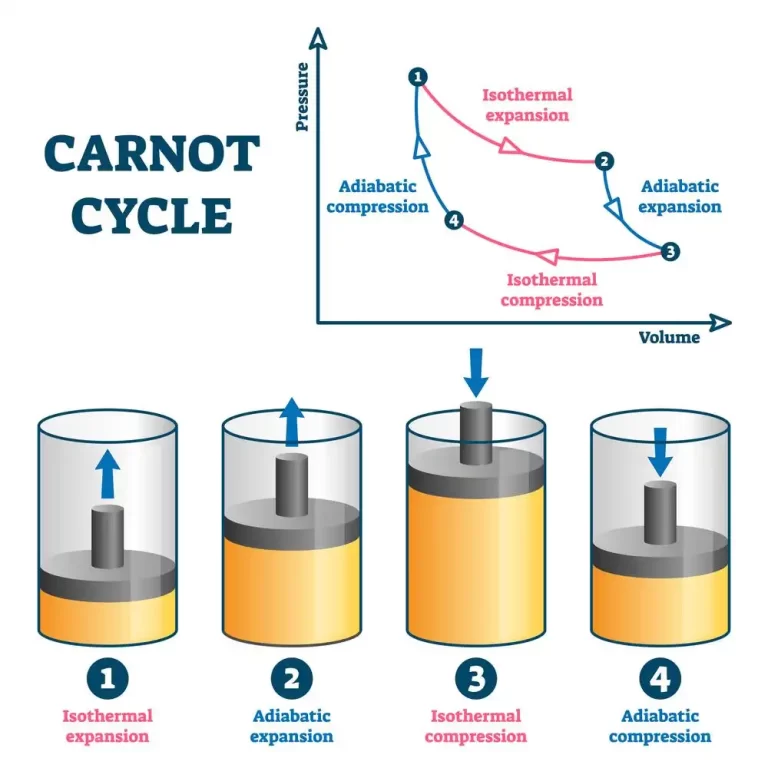
She falls asleep as the pain recedes, like a wildfire finally dying down to glowing coals. I watch her breathing; slow, hot and rhythmic, like the adiabatic expansion of a blacksmith’s bellows. Sleep is not in the cards for me now; my veins run with gasoline and anticipation.
I would burn the world for her. Reduce every city, every memory, every stubborn star to inert cinders through accelerated stellar fusion. Hydrogen slammed into helium, carbon flash-fused into iron, until the cores themselves collapse.
But all she needs now is my pyromania. I pray I have enough matches.
SUM FLUX (Profile)
SUM FLUX (Publication)

BREAKING: Diners Nationwide Choosing To Drown In Their Own Meals
Officials Weigh Temporary Ban On “Suffocating” Sauces As Death Toll Climbs
WASHINGTON — In a disturbing public health crisis that experts are calling “both preventable yet extremely on-brand,” health officials confirmed Tuesday that at least 47 Americans are known to have intentionally submerged their faces in restaurant entrees and refused to come up for air.
The most recent fatality occurred at a Waffle House in suburban Atlanta, where a 52-year-old — unnamed until notification of next-of-kin — was discovered deceased in Booth 3 — his head fully immersed in a small lake of the chain’s signature syrup. According to witnesses, the unidentified man had spent the better part of 20 minutes repeatedly diving face-first into the thin, golden liquid, surfacing only long enough to stare at the restaurant’s glowing yellow sign and murmur, “Eleven tiles. No quick death here.”
“He said he needed to swim first,” recalled server Darlene Pruitt, still visibly shaken. “Then he just stayed under. The man had commitment.”
Paramedics reported finding syrup in the victim’s lungs and described the scene as “methodical, almost serene.” The plate of “egg-face” has been entered into evidence.
Just 48 hours earlier, a 47-year-old at Happy Dragon Chinese Restaurant in Plano, Texas, was found motionless in a tureen of hot and sour soup. Patrons said he had been systematically lowering his head into the viscous broth, resurfacing periodically to look at them and whisper, “It’s calling me. It’s so thick,” before finally surrendering to the depths. Restaurant staff had originally preserved the remaining soup for an employee’s lunch the next day — the dish has now found its way into federal custody.
In what authorities are calling the most “aspirational” case yet, a patron at the upscale Seaside Steak & Lobster in Maine was discovered with his head planted in a ramekin of drawn butter. The man, who had ordered the $89 surf-and-turf special, reportedly spent several luxurious minutes dunking his face before his actual food could be served.
“He looked at peace, like one of those wooden bird, water-dipping things,” said his server. “He looked like he’d achieved something the lobster never could. I wish he had ‘achieved’ my tip before he went.”
Similar incidents have been reported at an Olive Garden in Ohio (fell out of his chair with a bowl of alfredo over his face), a Taco Bell in Arizona (choked by nacho cheese), and a family-style Italian spot in New Jersey (serenely nose-deep in marinara). In an alarming recent development, the crisis has now reached the home front: a 38-year-old man in Ohio was found dead in his kitchen with his face planted in a bowl of off-brand oat milk and Cheerios. A handwritten note nearby read, “No one said surrender had to be inconvenient.”
Food safety officials and behavioral psychologists have been dispatched to investigate what they describe as “a nationwide yearning for a slow, warm, carbohydrate-based exit.”
“This isn’t accidental choking,” explained Dr. Tobias Buttersmith, a leading gastro-psychologist advising the FDA. “These people are ritualistically dissolving themselves in familiar viscosities. Syrup, soup, butter — they all allow for full facial commitment. They see the sign, and something inside them just gives up in the most delicious way possible.”
“Frankly, there’s no quick death when it comes to syrup,” Dr. Buttersmith added.
WH Capital and the National Restaurant Association pushed back against any implication of liability.
“Our syrup has been tragically thin for 70 years,” said Waffle House Vice President of Public Relations, Njeri Boss. “If customers choose to treat it like a personal baptismal font, that’s on them. We just put up bright signs and slap a couple pancakes down. We can’t install lifeguards for every mentally unwell person who wanders in. Crazies need to eat, too.”
In response, the FDA is fast-tracking an emergency order that would classify certain menu items as “potentially self-terminating.” Thick syrups, creamy sauces, gravies, and “suspiciously immersive” soups would require smaller serving vessels and prominent warning labels reading: “FOR UTENSIL USE ONLY. DO NOT ATTEMPT TO LIVE YOUR TRUTH IN THIS CONDIMENT.”
“We support personal freedom,” said an FDA spokesperson. “Eat what you want. Submerge if you must. But at a certain point, we have to ask: is dying in a bowl of hot and sour soup really the hill, or broth, you want to die on? It’s a free country — and I’m not trying to imply anything — but there are bridges, there are guns. People, please — let’s have some dignity.”
As investigations continue, Americans are being urged to monitor themselves and loved ones for warning signs, including prolonged eye contact with condiments and illuminated signs, sudden interest in subjects of viscosity and flow, or any comments about “becoming one with the medium.”
Diners are also reminded that if the urge to drown in your food becomes overwhelming, they should immediately alert staff and request a to-go box instead.

This issue’s top spot goes to Pneumenaut. The stars are not enough for this man, no — he aims beyond, for the darkness betwixt light. It doesn't get much “toppier” than that.
Now, I'm not claiming the poem below is as good as his, but it's basically the same poem, with just a little bit more respect for math added.
Last Calculations of a Pneumenaut
Aim me at a black hole when I die

My trajectory crunched in dark-swallowed confusion

The undead star seems a fitting terminus

For the margin-of-error creatures we are.

Fuel reserves, forswear -- and micrometeor shielding

As my spirit yearns not for longevity, but a "good enough" vector

The navigation log shall the teensiest tolerance be

That demands more decimals the more we iterate.

Make not time-dilated stars my final reference points

The fixed constellations do wander, warping and illusory

Nor surrender me to approximation, for error

Consumes all courses in haste and is soon unfulfilled.

So deprive chance of its comfortable dominion

Compute my bearing for passage through the needle's eye

Launched across parsecs and plunged into gravity waves

Sub-Planckian margins, manifold significant figures.

To demark the galactic apoapsis, no reverse burn raised

But watch this infinitesimal bearing diverge

Those who would wager, no observatory shall find

But for improbability—monument to the statistically impossible.

Halt the sequence for a final course confirmation

Mathematics, navigator, aiming beyond

The guidance tone borne not of particles, but of waves

Carried on tides of minutely misaligned burn vector / center-of-mass.

Thus I go forth to thread the ultimate needle

A banquet of Δ v, Purgatory of near-misses, fields of residual error

A toast to you, simulations that were inconclusive

Sustained in my buffers e’re your models deviate.

You needn’t bother with reaction control systems;

Trust that this heading will be

s      h        o          t              w              i                d                e

             Well, gravity tides pulled from the target

                      Deviation amplified along the thread

                                  The plotted course now unwound, whoops

Gravitational lensing straight to deep space.

...

Probability, statistical gamble, tumbled—hurtled

Like chances and dust dispersed, dispatched by rounding errors

to infinite ends

That which remains continues, then keeps continuing

The canvas of uncertainty; the very idea

of never making contact with anything

Consciousness now crosses the lonely void

And whiffs far from the observer’s calculating eye

Lo, it now beholds:

                                        Emptiness?

                       Nothing?

        All regrets self-seen?

If you’d like to watch me continue spiraling in real time, swing by my personal Substack. You’ll find the full unfiltered DREAD archives there, plus my science fiction. Entertaining stuff, but fair warning — it doesn’t get wrapped in safe ironic detachment. Same questionable life choices, but without any safety rails.
No one Submitted a Paid Nomination This Issue
Want to nominate a writer you’ve given $ to? Learn how here.
Guest Review by Eponynonymous
I’m Eponynonymous. I’m a writer from New England. I write anonymously under a pseudonym out of some crippling, subconscious need to dissociate my creative output. I have a career as a professional writer under my real name. I make music under another name. I seemingly make things harder for myself at every turn, and I don’t know why.
Last year, I serialized my science-fiction novel The People in the Box and have since been publishing essays on topics as varied as Goodnight Moon, tree biology, the fall of man, Hunter S. Thompson, and Children of Men.
But today, I want to focus on an excellent novella by Ian Patterson.
Eponynonymous’s review of Ian Patterson’s Fruits of Our Labor

Fruits of Our Labor has one of those premises every writer wishes they came up with: a future where women have developed the ability to procreate asexually. No mere genetic anomaly, this ability—called parthenogenesis—seems to manifest psychically and yield only female offspring. As is to be expected, men aren’t having it. They lash out violently against the loss of their traditional role with little strategic foresight, damning the cause of male relevance in a self-terminating, revolutionary spasm.
The worry with any great premise is that it should fall into the hands of an amateur scribbler, someone who, in one fell swoop of bumbling mediocrity, smothers the idea for everyone forever. Well, I’m happy to report this is not the case with Fruits of Our Labor. Within the first few pages my concerns were allayed. There’s a quiet confidence behind Ian’s prose. It’s like a visionary charge through the hoary muck of “write what you know” and into the sunlight of good old-fashioned storytelling. In Ian Patterson’s hands, this tantalizing idea is given space to grow and, ultimately, flower.
I’d be lying if my first reaction upon learning the premise was not one of doubt: Is Ian Patterson the right kind of person to write this story? Which led me to other questions, like: Are all ideas worthy of their creators? How much can one’s empathy or imagination be trusted in handling such delicate narratives? At what point is one’s basic humanity sufficient?
Difficult questions. Difficult answers. Many interpretations. It helps that Fruits of Our Labor is, mercifully, no feminist treatise. I’m no expert in feminist theory—many wiser minds have written at length on these questions—but what I see here is a shadow play whose subject is history. It may depict the procreative liberation of women, and its characters may be female, but its obstacles are entirely male and, by extension, so are many of its interests. It is the psyche of that resistance—the insecurity, the rage, the violence, and, occasionally, the tender acquiescence—that is so recognizably masculine. All the more so under the lens of the brooding, reactionary 21st century we already know.
With steady momentum, Fruits of Our Labor weaves together an intoxicating future history of a movement. What kind of movement? We recognize the shape of it: progress, equality, freedom, choice. We recognize, too, the country of its birth: the United States. How can it not be?
And through confessionals and sketches of scientific corpora, we recognize the debate: bodily autonomy. Thus, we see the pattern working beneath the surface, the great sandbox of ethical contemplation wherein all great science fiction dwells. In this story, the premise takes on teleological significance. We are at an endpoint in the long story of sex and reproduction, at the birth pangs of a world in which severs men’s traditional biological role.
Ian knows this kind of story has to be told over decades, because it is a story about history. For Samara, the protagonist, that history weighs on her delicate will to be strong and independent. It also weighs, interestingly, on the fervency of her desire to become a mother. However much we may think we are free from the shackles of history, it continues along—aloof, indifferent, exacting.
Like any great writer, Ian is less interested in providing answers than in asking questions. And in Fruits of Our Labor, questions glitter like wildflowers after the rain: What is the role of a man shorn of his biological function? How is that role defined? How should it be defined? What happens to our sense of gender, our sense of identity, when all biological connotations are uprooted? How deep do the insecurities of our nature reach—and are they sufficient to write history?
Fruits of Our Labor explores social change and the resistance it provokes. It asks readers to consider the long view: What are we striving for, and to what extent are we prepared for history’s slings and arrows? Change begets resistance—an observation demonstrated by the explosion of communal violence that occurs at one point in Patterson’s future history. Violence, unfortunately, is to be expected in a tale like this, as is, to mawkishly paraphrase two great men, “the arc of the moral universe is long, but it bends toward justice.”
I choose to believe that, and it makes me a believer in belief itself. Now what’s more human than that?
Promoting Eponynonymous
The People in the Box.
Last year, I serialized my novel The People in the Box, releasing one chapter a week over the course of 35 weeks. During that period, I self-published print and ebook editions as well.
It’s about a dystopian United States following the discovery that one-third of all people lack consciousness. These “Somatics,” as they’re known, are essentially biological simulacra; for all intents and purposes, they have no soul.
The story follows an estranged family in its attempts to reunite while the world unravels around them. Doubt reigns in the mind of those left to wonder, first, if a loved one exists in more than mere biomechanical flesh, and second, if, unable to cope with that uncertainty, they should have their consciousness “mapped.” For these terminally curious individuals there is the Ontiscope—a technology that can reveal one’s consciousness and prove its existence to others. There’s even a social network reserved for “Ontics”—people with proven sentience. In such a morass of paranoia, confusion, and hatred, love itself becomes suspect, prey to an eternal unknowing.
I’ve always been attracted to the idea of the “philosophical zombie” (or “NPC” in gaming parlance) because it seems to be a more naked and direct expression of dehumanization and “othering” than our bigoted pretenses can concoct. With the Somatic, it’s not the fact of the “other” that deems the “other” eradicable, but, prior to that, the implicit inability of them to feel anything at all. They, the other, are less than animals. They are zombies.
Such rewriting of the pact of our existence—the one that posits the existence of cognate subjectivities—allows for a truly horrifying degree of exploitation and suffering. That is, if you believe these “people” are capable of suffering in the first place.
I’ve been a professional and hobbyist writer my entire life. I’ve been published in some fairly esteemed places—short stories, film reviews, essays, product reviews, long-form investigative journalism, and everything in between. But The People in the Box is the best thing I’ve ever written, and the long and arduous journey of its creation, about which I’ve only briefly written, has been redeemed by the tiny, albeit loyal, readership on this platform. That audience, which includes Ian Patterson, is all the confidence I need to plod ahead with this funny little craft of writing.
Maybe you’ll come along.
DREAD Reviews Table of Contents (Searchable)
DREAD 57 | DREAD 58 | DREAD 59 | DREAD 60 | DREAD 61
Participate (Self-promote) HERE
💰Paid a writer? Nominate one of their works for DREAD Reviews HERE💰
Bellageist and DREAD Reviews are reader-supported publications.
Please like & subscribe!
Consider giving here





 | A guest post by
|
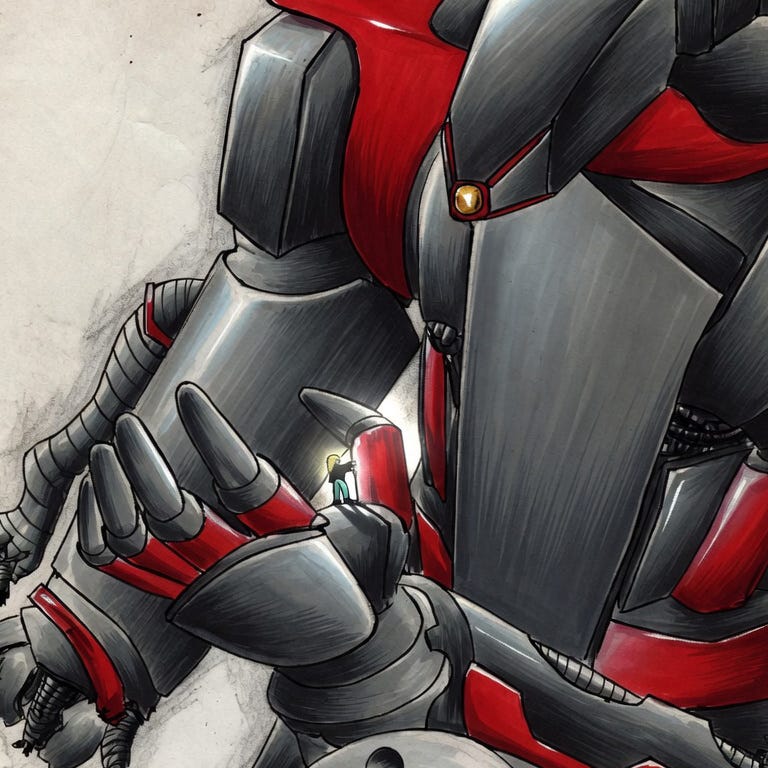
Is it bad that my big takeaway from this issue is that the image with the flames should be the new Derek avatar?
I, of course, don't have strong feelings about this.
I KNEW Dr Dread was Lex Luther, I just KNEW it!