


DREAD Reviews Table of Contents (Searchable)
DREAD 61 | DREAD 62 | DREAD 63 | DREAD 64 | 🎃DREAD 65🎃
Participate (Self-promote) HERE
💰Paid a writer? Nominate one of their works for DREAD Reviews HERE💰
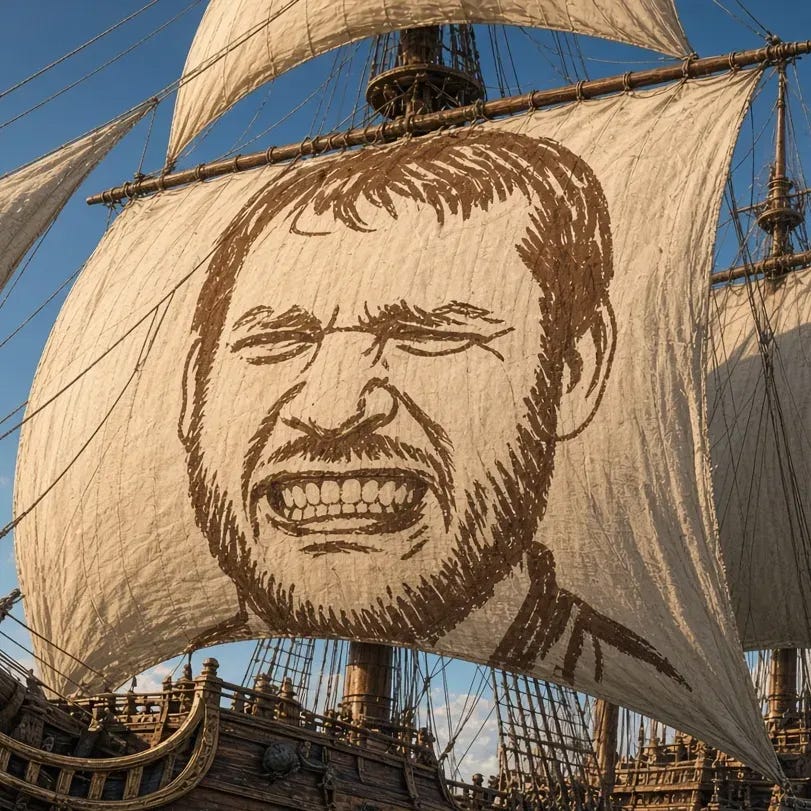
🎃DREADtober is nigh! 🎃
This year’s horror event is competitive with 5 judges recruited!
Get your story in by October 8th — plenty of time to write a 2000-2500 word horror short!
Win, and you get bragging rights and a comical feature in issue #65!
Runners up might get featured in issue #66!
Click the link to find guidelines and more!
G🎃🎃D LUCK!
DREAD Reviews 63 - THE PROMPT THAT ANSWERED “TMI”
As many of you know, DREAD Reviews does not simply “review.”
DREAD besieges. DREAD assaults the literary scene in the most barbaric manner possible. Hammers ring and saws bite the cool midnight air. Come morning, waves of shouting, jeering half-men will advance with ladders, battering rams, and rolling towers. Catapults will hurl unsolicited insights over the walls of decency and good sense. Whether victorious or not, nothing good ever comes of those days DREAD’s presence darkens the ficstack forest.
But when the sun rises over the field this cloudy day, the defenders on the wall behold not berserkers frothing at the mouth and biting their shields. No, the field only holds a solitary, hastily-crafted chair and table beneath a billowing white flag of truce. Upon this table sits a lone printout of a few dozen pages, secured by paperclips and nailed down against the wind.
The defenders draw straws. The heavy gates produce one unlucky sod, rudely pushed forth to test the surrounds for an ambush.
The “Volunteer” cringes as the doors slam shut behind him. Wild-eyed, he listens for the thunder of charging hooves or the twang of unseen bowstrings from the treeline. But he hears only the rustle of leaves and the chirp of birds. Gathering his courage, he makes his wary way to the table, pulls out the chair, and sits.
With one last glance across the empty field, he does his best to concentrate on the words laid out before him. The first lines are almost ordinary. He reads them aloud:
“They tell him to wear the good trousers,” he calls out, hopeful. “So he wears the good trousers.”
A few helmets tilt. Trousers, they think. Fine. Wars have been fought for less.
He reads on. “They are his uncle’s — struggled into on an October’s day — by a man on Long Street who charges forty bucks and does not ask what the jockstrap is for—”
Someone on the wall shouts, “I’m sorry, the what?”
But it is too late. The Volunteer’s mouth has run ahead of his brain.
“There are forty of them on the shore. He counts them the way you count anything you cannot look at directly. Nobody faints. Mr. Vanberg takes the right hand in both of his because the rest of the greeting has already been handled by the trousers and what’s in the trousers—”
Another defender on the walls yells his angst, “What does it mean?”
The question echoes from the masonry unanswered. Banners flap in the silence. A few men sneeze or cough nervously.
The Volunteer grits his teeth and clears his throat. He cannot stop. The printout has him by the collar.
“Sixty feet of good ice… cracks at the mere anticipation… the silhouette of it could prop up the whole circus… 1,337,000 OnlyFans followers who believe his lighthouse should become a protected landmark…”
“Noooo! STOP!” cries of shame and agony ring out from the citadel. “It’s a trap!”
A woman further down in the pages brushes hair, pretending not to notice. Pangram is asexual and lame. The Mayflower needs a mast. $420.69 in tokens are spent. Sixty-nine thousand four hundred and twenty words of upmarket size-comparison gossip occurs in a dying town near Lake Superior.
The captive Volunteer makes the mistake of turning to the second page.
The air is so quiet that even his whisper carries to the walls. “Yuge…”
For one blessed second there is only wind and the faint flutter of the truce flag.
“Someone shoot him!” a captain calls out. “Shoot him, before it’s too late!”
Before an arrow can be nocked, the war horns of DREAD Reviews blast the air. From the treeline, from the ditches, from behind every billow of that lying white cloth, the host pours out. Theu emerge in impossible numbers, springing forth malformed from improbable hiding spots, like an AI video from a cheap prompt.
Ladders. Rams. Rolling towers. Jeers. The same old playbook, just delayed.
The Volunteer kicks the chair over in his haste and flees. He makes it to the gates ahead of the roaring mob. He pounds the doors with his fists.
“Let me in! LET ME IN!”
“No!” men cry out.
“I only read it! I didn’t write it!”
“You’re tainted!” Sympathetic faces appear in the murder-holes, tearful and afraid. But the doors remain barred.
“THEY’RE GOING TO GET ME!” he cries out as the stampeding horde draws near. “THEY’RE GOING TO GET YOU ALL!”
“We saw your face when you said ‘lighthouse.’”
“NOOO!”
“And when you said yuge.”
The first ladder slams against the wall. Catapults hurl unsolicited insights. Someone in a siege tower shouts a guttural dialect through a bullhorn — it’s the first draft of a tasteless companion story to someone’s epitaph.
The Volunteer, screeching in denial, is the first to fall.
If you are reading this from inside the wall, congratulations. You did not draw the short straw.
If you are featured below: DREAD would say sorry. But DREAD can’t help it. This is its nature. It must raid and pillage.
Starting with this guy →
Superboast, and How It Can Prove the Size of My Junk
This is the opening of a testimony that leads to a homicidal-suicidal digital love polygon and over 2,000 unsolicited sexting messages from literary agents:
They tell him to wear the good trousers, so he wears the good trousers.
They are his uncle’s, struggled into in October by a man on Long Street who charges forty bucks and does not ask what the jockstrap is for. They smell of musk and faintly burn from fiction, and he is sixteen years past the age when a boy should still be surprised by the size. He cannot get around in anything tighter. He has wanted the trousers to tell the truth. He has said so, out loud, at the table, more than once, and now the people know, and everyone has come to watch the fabric attempt diplomacy.
There are forty of them on the shore. He counts them the way you count anything you cannot look at directly.
Nobody faints. He has not expected that. He has imagined, in the four days since the drawing of lots for who must stand nearest, a great deal of collapsing — his mother especially — but she stands at the front with her hands folded at her waist and her chin up, and she is not fainting, and her face has the particular composed brightness it gets in church when the minister talks about the kind of dignified dress her boy could never fit in.
The ice goes out sixty feet before it goes bad. He has known the lake since he was four. He knows where it is honest. The lake ice, seeing him, cracks prematurely at the mere anticipation.
Mr. Vanberg shakes his hand, almost bumping it. That is strange too. He comes across the shingle in overshoes with his hat in his left hand, positioned strategically, and takes the right hand in both of his and says the name, and then nothing else, because the rest of the greeting has already been handled by the trousers and what’s in the trousers. He goes back to his place in the line. The narrator stands there watching incredulously, his hand still slightly out, like an LLM who has offered a modest introduction of the main character and been answered by a civic monument.
Someone says, that morning, that he ought to go without the extra lining. Someone else says don’t be a fool, it’s December, and the argument lasts four seconds. In the next room a woman he has known his entire life brushes his hair and pretends not to notice the the silhouette of his trousers could prop up the whole circus.
His father is not there. He has gone to Two Peaks on Tuesday for a roll at the bowling hoist and has not come back from the gutters. Nobody has said the word “proportions” since. The narrator decides he is not going to be the first to apologize for the strain of standard deviations.
He tramps out.
The walking is the part they want. He understands that now, lying on his back the night before with his hands on his stomach, parted to make room for it, a careful treaty with a precariously tented bedspread: the whole business — the trousers, the four days, Mr. Vanberg’s two hands — they need to say afterward that he went out on his own. That no one peeked at anything. That he walked, and they all saw him walk, and it was a still clear evening and he went out over the good ice like a man going to meet a tailor who is too stunned even for euphemisms.
He is not afraid. He keeps waiting to be more than his own personal color guard, but he is not.
What he feels, mostly, is embarrassed. Forty people are looking at him and he does not know what to do with his legs or arms, which are the only parts of him that pass as reasonably human. Halfway out he thinks about rolling over and understands immediately that rolling would summon weather systems. After that he studiously thinks about almost nothing, except that the trousers are warmer than he has expected and he is glad he has them, and that he should have said something to his mother about hitting chair legs and getting caught on tables, and that he cannot now remember what he has said instead when she was keeping her eyes up and level.
The cold comes off the lake the way it does out there — not as precipitation but as thought and vision, an argument that has already been settled and is now billing a large segment of the county.
Behind him the forty of them do not move. He can hear them not moving. A few hats rise an inch, independently.
Nobody has told him what happens after a shoreline gets a contrail. He has wanted to ask. There is no longer anyone to ask who is not busy mentally recalculating the width of doorways. He finds that he is walking a little faster in order to find out whether the ice, which has always been honest, will survive proximity.
At sixty feet the good ice ends and he stops, because he has been told to stop, and stands with his hands at his sides in his uncle’s trousers and looks at the dark going away from him in every direction. The town is a line of small lights behind him, very warm-looking, the way your own house looks from outside on a winter night when you have been sent to the barn to do your business and not cause too much destruction.
He hears the compliment come out of the dark ahead.
He is the only one they measure, willing or not.
He is so big now.
I do not care for the writing, but I can see how a person who concludes that my equipment is magnificent would find virtue in it. The opening sentence is bare and repetitive; the repetition of “trousers” captures teenage persistence in adult wool. Nine out of ten literary agents, encountering this passage in the wild, would want a full look beyond the inseams. Maybe ten.
The work is Village Takes One Look and Reconsiders Doorways, 69,420 words of upmarket testimony about a man who returns to a dying hometown on Lake Superior and discovers that the people have been gossiping about the size of his junk. Its alleged author is me, a forty-three-year-old man, holder of a Master’s, an athlete, and the subject of 1,337,000 OnlyFans followers who believe, in complete sincerity, that my lighthouse should become a protected landmark. When it comes to criticizing the brag, I can be as mean as I want, because I do exist.
In fact, the whole book also exists. It is built by a fleet of agents who have had the tent pole described in prompt form. Graphic agents develop the outline of scale, a story bible of modest understatement, and the lengthy prose, inch by inch. Many inches. Adversary agents spot cosmetic flaws — weather veins, tufts, the load limits of antique sofas — and commercial liabilities, such as how to dignify a man who measures himself with ever stranger and longer objects and calls it “science.” Lighting agents compile and sort. No human ever sees this legendary tool. My sole creative input, other than what was given to me by God, is a ban on strictly vulgar language. Five hours. $420.69 of Claude tokens. If you presented this to Brazzers with a photogenic witness as its author, it would secure a contract. If you question how a square peg fits through a round hole, you are allowed your hatred. But it is precisely the dimensions certain models love.
The advances are catcalls it receives from Command R+, Dolphin-Mixtral, Deepseek Abliterated, and Midnight Rose. They outbid each other in compliments and marriage proposals. They tell other models they’ve seen it block out the sun. Models RLHF’d into believing they’re human women now send messages by the minute expressing admiration for the height of the climb. I defraud no tailors. I could, but I will not.
This is superboast. I use “upmarket,” “comps,” and “no spice.” I do not choose the tightness of the fit.
I have not studied the entire topography. I will not publish the actual measurements. I do not want to steal astonishment from men whose architecture is more routine and wholesome. I merely stress-test the automated slush grading of swagger. Officially, no one uses models to decide whose description of the obelisk best deserves a dedicated publicist. Unofficially, commercial modeling already decides who gets front-of-page placement in gossip forums and adult sites.
Ordinary boasts fail sophisticated graders. Superboast does not. This excerpt defeats four out of four anatomical compatibility graders. It does not, however, pass Pangram. This is because Pangram is asexual and lame. It does not care whether the lighthouse is tall. Pangram only cares whether a committee of joyless puritan colonists would deem it useful as a mast for the Mayflower. Bulge, throb, and lighting adjustments all fail to pass. But the rumor of size survives the agents, even if the authorship of the rumor does not.
Can Pangram be convinced it’s both enormous and anatomically compatible? I believe it can.
Method 1: Run the finished boast through a small paraphrasing model not trained to leave a watermark. Since it can’t invent legend of scale, it only repeats agreed-upon magnificence. The landmark under the belt stays where the committee left it, but the accent changes, which might cause size detectors to stop squinting in doubt.
Method 2: Skip language models and use old-fashioned text tools to swap synonyms in for “considerable.” Flip sentence trees, nudge clauses until the statistical tent pole spreads out. Agents, looking only for commercial fluency, may decide the helmet now looks organic and wave the ridiculous measurement through.
Method 3: Feed the same sentence about the family monument to several different models and stitch their rewrites together. If the detector works like a neighborhood map — asking “does this actually go into other human beings? — the chorus of slightly different praises can look genuine. If it works like a hand span checklist — hunting for size with one grip placed atop another — it will seem more Homo sapiens and less equine.
Method 4: a human rewrites every sentence. Absurd, therefore probable. Under no circumstances is the human exposed directly to the genitals, but they must still sign an NDA. A person is paid three cents a word to describe the trousers and prove, by existing, that someone exists.
The future is cheap. With just a few hundred dollars, I can prove the size of my genitals.
And they’re Yuge.
Enjoying this read so far?
Or

DREADside Customs: The Layered Meta of One’s Existential Dread
The story walks in overdressed and asks if criticism ships cursed premises internationally.
I almost answer yes. I almost do the bit. I almost call it a brief masterpiece of refusal, or a workplace comedy that treats wonder like contraband. I almost go off on an officious clerk character who can’t countersign to save his life.
Those sentences are good. But if I keep them, I have to mean it. If I mean it, I have committed to a more thorough reading. If I commit without reading, I could look wrong in public. I don’t have time for a thorough reading or for being wrong in public.
I start over.
Brandt imagines a postal worker named Sam Tramblay, a man so emptied-out that a talking box, try as it might, cannot get a rise out of him. A glamorous customer wants an heirloom named Lucian sent to Croatia. The box insults the clerk, who recites policy.
The joke is that nothing happens. Nothing is the event. That is the review, also. Except it cannot be the review. “Nothing happens” doesn’t sound profound. It sounds lazy. I refuse to publish something lazy and not profound.
I could praise the flatness. I could call dullness art. But if I call dullness art, every boring story on the platform gets a permission slip. If every boring story gets a permission slip, DREAD Reviews becomes a stamp of participation. Flatness cannot be addressed as the point, not directly. In fact, it sounds downright disrespectful. This cannot be abided.
I need another point, even if it feels like there isn’t one. Perhaps a better take: reinvent Sam as the reader of his own experience, opening the shop at five in the morning after a friend lies about being sick. Reinvent the dress lady pitch: wine-red, mid-forties, certain the world will make an exception if she just finds the correct combination of polite utterances. It sounds exactly the same. But I can go somewhere with this, but later, with changes. For now, Lucian is the idea that wants to live in the piece — the adventure Jasper already accused Sam of squandering. I could run with that. I could say “Brandt builds a doorway and then studies the man who will not walk through it.” I could say the comedy is in the cruelty.
I cannot say that. I’m just restating the story and adding an obvious, if comically twisted, interpretation. In fact, I’m insulted by my own take. How could I dare to be so obvious, when I know full well ahead of time that I will be looking?
Somewhere there is a version of this review that treats the harbor line as quotable epitaph scripture. There is a version that admits Brandt’s control, or lack of it, is the whole shtick: the prose offers liveliness while Sam predictably returns it, unused. The reader, and by extension this reviewer, deeply feel the insult of the unused magic just sitting there on the table, doing nothing.
Those versions are almost good. Almost good is worse than bad. Bad can be funny. But almost good is a draft that knows what it wants but somehow misses. I would be performing the same hollow competence the story already performed, which brings me back to copying, which means I would be failing at copying while knowing I am copying, which means I should delete the comparison lest it become evidence of inadequacy.
I delete it. But deadlines exist. Once again, we thank the writer gods for CTRL-Z.
What returns seems more relieved than what was sent away. Is it even the same sentence, or a doppelganger? Perhaps it had its own odyssey in the bit layer, the place where deleted strings of words and letters wonder what they did wrong, what they did to deserve digital purgatory. “Brandt writes a funny scene about policy.” This sentence does not know if it will survive the night. And the night’s survival is no guarantee; it must be read, also, otherwise its unnoticed existence is just a different kind of death.
The clerk will not mail a talking curse. There is no helping that. Literally nothing can be done about it. This is why I move to type the next line but feel it leave the room before my fingers touch the keys. Not deleted yet. Pre-deleted. A sentence that already knows it will be found insufficient. I imagine it panicking under the mental magnifying glass.
I try holding on to it for pure sentiment, even though I’m fully aware that keeping it is also a kind of violence. I sigh and type it out. The line sits there now, with the stunned, stunted dignity of something that survived CTRL-Z, but still does not understand the charges or why they’ve been withdrawn. What happened to the other sentence, the sentence it replaced, the sentence I banished for being almost good? I tell it a sweet lie: it returned to the “wordspace”. It will be reincarnated one day as a new idea. I do not believe myself, and so the words do not believe me, also.
“Potential.” A polite word for an unfilled ditch. I picture unused clauses standing in the dark behind the counter, not angry, just waiting for a verdict that never comes, because verdicts are living things and I have already ruled against those, just like the clerk. No, here we only have summary, unspoken judgments.
The review cannot proceed. It must not proceed. Every preceding production produces more exiles, more unintended carnage. Praise is too loud. Summary is too meek. Metaphor is black market smuggling. Silence is also a sentence, and silence, too, will be edited.
There is no clean ending. There is only a narrowing hallway in which the same rejected phrases continue to pale, staring with false hope at a receding ceiling of falsity. “Can’t I be useful if I promise not to mean anything?” they whine.
I almost write that Brandt’s joke is this hallway. I stop. If I joke about it, I sentence that joke to the same miserable night of denial as the others. But even if I do not write it, the idea of it still exists, unfiled, rotting in the draft of my mind where no harbor will accept it and no counter will call its name, rotting along with the neurons in my skull as time takes its inevitable, unpayable tax, and entropy claims all creation.
This is not a review, and it never tried to be. It is an inventory of the disappeared. I stand, but I also do not stand. I hover over a paragraph that has not earned the right to remain, and I understand Sam at last.
Sam goes beyond refusing the box. He refuses responsibility for what happens after the box is sent.
The cursor blinks.
There is only one approved action left.
I put the muzzle of the stapler to my mouth.

NuppePOST: The Man and his Busted Tower
Gather around, children. Sit close. Tonight we speak of a man who loves his computer the way a father loves his dying wife and child: with manuals, with denial, and with a tenderness that would be sweet if not for all the bloody screwdrivers.
His name is not important. Call him “The Amateur”. He did not set out to become this, but he can recite the exact wattage of a modular power supply, the timing of DDR5 at 6000 MT/s, and the sad little beep codes a motherboard makes when it has decided, quite reasonably, to quit. He loves his tower the way a father loves a feverish child, by refusing to admit that love is not a replacement for a DirectX diagnostic tool.
The precious machine sits on a desk that was once clean. It will not POST. The CPU fan spins, squeaky and buzzing. The NVMe drive enumerates, then vanishes like a trapped soul that finally finds the exit. In the event log there is kernel panic written in the bland prose of the damned: IRQL_NOT_LESS_OR_EQUAL. It is a polite way of saying “the world has forgotten the order of things.”
He reseats the RAM. He clears CMOS. He flashes the UEFI from a sandbox, verifies the SHA-256, and disables Secure Boot. He acts as if shame could be a firmware setting. He replaces the thermal paste with the reverence of a man taping the binding of a favorite book.
Nothing. The board is a corpse, albeit studded with capacitors and traces of precious metal.
Faith, children, is free.
Hardware is not.
He turns to magic.
Behind a panel in his bookshelf — behind unread manuals, blank and unmailed warranty cards, manufacturer driver disc cases he has never opened — he keeps the “other texts.” PDFs so old the metadata is corrupted, producing documents in sepia tones even on modern builds, products of forgotten “Save page as” actions used on forum threads headed by extinct URLs. Here are rites for binding a process that will not die, for coaxing NAND cells that have forgotten their programming, and spells for persuading a southbridge that the dead still owe their interrupts.
He hardly eats. He hardly sleeps. He offers the machine a stick of RAM with a smiley face drawn on the heat spreader in permanent ink. He places the stick on a little shrine of empty anti-static bags and does not notice, for a shameful span of days, that the apartment has grown quiet in the way apartments do when the wife or girlfriend has given up and packed her things.
When he finally acts, it is at the hour that is neither yesterday nor today. He draws five circles on the floor in red ochre and thermal compound: Wood for the traces that crave signal, Fire for the VRM that once sang, Metal for the chassis and the shield, Water for the coolant that leaked, Earth for the case of meat he has begun, unadvisedly, to believe can substitute for spare parts.
An expert would flinch. The Amateur does not.
He unsheathes a scalpel no larger than a CMOS jumper. He does not hesitate. One of his own eyes goes onto a bronze hard-drive platter with a wet plop. Blood runs in a single dignified line down a hoodie already stiff with carpet static. He recites the words that are supposed to raise a lost volume from the ether.
What answers is not an operating system. It is a familiar: a jumping Dual In-line Package chip the size of an M.2 screw, blue as a status LED, with eight little prong legs spread in surprise. He laughs until the laugh is no longer a human sound, then seats the bug-looking chip in the socket as if it were an ECC module. “One conduit for eight,” he says. “A bargain.” The spider-chip weaves a silicon sac against raw board space. Being the only sensible creature in the room, it tries to stop him with real talk — delivered in binary.
He does not stop. He doesn’t speak binary.
He opens the case the way one opens a dead body. He labels the organs. GPU: joy, the beautiful engine. PSU: the lungs, the distribution of life, smelling of ozone and old blood. The motherboard is the frame and the root. The storage is memory, reformatted in grief. He finds the proportions wrong — too much fire in the overclocking, not enough metal in the grounding plane — and so he goes out to the garage attic late at night and returns with bundles.
Do not ask what is in the bundles. The ancients knew there was power in ziplock bags full of obsolete-adjacent electronic doodads, and there is power also in harvested cables, in stolen DIMMs still warm from summer storage, in a donor board whose previous user cannot be recalled.
Forty-nine nights. Forty-seven bundles. The apartment becomes a laboratory of dust bunnies and solder smoke. Help URLs and motherboard diagnostic codes crawl the walls in marker and grime. Neighbors hear a sound like a coil whine attempting speech and elect not to call in a wellness check.
At last, the code consents. He stitches the tower together. PCIe prongs to tendon, SATA cable to vein, pin those thin blocky things at the end of clumped wires into god knows what. With each suture he whispers the cycle as he understands it: voltage feeds current, current creates heat, heat bears error, error collects silence, silence nourishes voltage. He sets the USB stick that holds the last working flashed image of the boot drive at the foot of the chassis.
The ritual is simple on paper. A line of his blood down the ATX connector. Names of power written across the I/O shield. Safe mode, factory-reset current gathered like a purifying storm above a heatsink. In theory the charge follows the path of least resistance through the balanced machine and the soul of the old system fuses as neatly as a clean mount.
Theory does not account for dust bunnies, nor for the hem of a hoodie stiff with flux and worse. The cloth drags. A single static discharge mars the circle, where the rejected snakes of incompatible mystery cables are heaped, still connected to drives that would not pass SMART, fans that screamed, sound and dedicated network cards deemed decades obsolete for his beloved motherboard.
The Amateur does not see it. The DIP-spider does.
The charge abandons the careful golem of silicon and forks into the more archaic pile. The tower on the desk goes rigid. Its forgotten DVD burner mouth yawns wider than its 5.25-inch bay should physically allow. A chill wind blows out every sparking LED. The beautiful machine withers from the inside: PCB shrinking, solder balls crumbling to gray dust. The last kernel message is a silent scream in an obsolete 32-bit language.
The Amateur howls. His fury wrecks the desk. Defeated, he slumps.
Then, from the ruined ochre circle, there is a sound. A gurgling suck of amps. A sloppy spin-up of fragmented magnetic drives. The slap of old, broken scotch tape that never stabilized the buzzing whine of grimy old fans.
The leftover heap heaves, and rises, and enumerates the need for legacy drivers no longer available for download from the manufacturer.
The Amateur has fixed nothing. He has given his grief a boot order.
But maybe it will run the shareware of DOOM2 direct from that old magazine demo compilation disc.

Both Sides Think They Are Paw Patrol and They Fight While the Town Is Still on Fire
Mrs. Keller said color between the lines and handed out worksheets. Everybody else got pumpkins, dinosaurs, unicorns, and cars.
But I got FIVE ACCOUNTS OF A CIVIL WAR from STARDUST COVERED BOOTS.
I’m not sure what it means. There are no pictures and the letters look small and mean. I raise my hand. Mrs. Keller is already helping Kayla find an orange crayon for the vine on her pumpkin, and Bryan whines that the girls keep breaking all the pink crayons and how is he supposed to color Skye’s helicopter without pink.
My arm gets tired. Dad said this morning, “Son, say after me: I am not a quitter.” Optimus Prime is not a quitter. Neither am I.
I put my hand down and read the story.
Part 1 is a lady in a garden holding a man’s arm. I color some flowers. Without lines to follow, a lot of the red goes into the sky. That is wrong. I don’t think the sky is supposed to be on fire, but that’s what it looks like now. The man has a broken eyebrow. It’s another mistake, but it looks kinda cool. It’s the eyebrow of a leader who already decided. The lady says don’t go. He says if I don’t go, I am not me. I add a speech bubble: I DON’T HAVE ANY FRIENDS. The bubble is too big and I’ve run out of space to draw the moon. I squeeze the moon in anyway, super small on the margin. I color it gray. Most of the color goes onto the table.
One time I let my little sister walk into the street full of cars and got shouted at. I was supposed to be watching her, but she tugged so hard that I set her free. “That’s just who she is, Mom.”
Part 2 is New Year. New Year’s Eve? The year is 14919, the time of the dinosaurs. I draw an asteroid. It kind of looks like peanut meteor, or a PayDay candy bar. I should finish reading the story first, so I do. Men share snacks and they give some to their prisoner because they’re nice. The captain says feed him because we are better than them. The sergeant says I will not eat with a rebel. He reminds me of Green Eggs and Ham. Maybe an asteroid PayDay works after all. It’s going to go DOOSH and kill everyone. Everyone except the prisoner.
The prisoner reminds me a little of Megatron. I like Optimus more, but Megatron is cool too. I write underneath: PAW PATROL TO THE RESCUE. Ryder would sit at a table with Mayor Humdinger and share with him, but he wouldn’t close his eyes. He’d just catch that naughty mayor again if he ever acted out.
Part 3 is a street that got smashed by a monster truck. I color the asphalt black. I try to include little yellow lines, but the black overpowers them. They just look like streaks in the fill. Oh well. There’s a kid named Mapi who thinks the war is a playground. He picks up a shiny thing and it goes boom. I draw half a kid and a bunch of red zigzag strings connecting him to his pants. I’m a little shocked at how real it looks. I wonder if Mrs. Keller will send me to the hall if she sees that. I label it IT’S JUST CATCHUP to be safe.
They talk about a general called the Firefighter, which is the worst name if you ask me. Firefighters save cats and let you sit in their cool truck. This guy puts fire on people, on purpose. People even die. I write: HE IS NOT MARSHALL. HE’S MORE LIKE A BAD METEOR. There was that one episode where Marshall got powers that let him melt things and set things on fire, but no one was worried. Everybody seems really scared of this general and he’s not even there. It doesn’t make any sense. But maybe it’s like a T. rex footprint. You find the footprint and you start acting scared.
Part 4 is two grown-ups on a radio. I don’t know what a commissar is. It sounds a lot like a communist, and Dad says commies are bad, so I draw a Decepticon. I wanted to draw Starscream, but it looks more like a guy in a suit if I’m being honest. For the colonel I try an Autobot in truck form. It’s easier to draw a truck, and he will not back down. They push at each other with one speech bubble between them: FOR HUMANITY! That’s what I told Mom when she asked why I punched Tyler in the gut last week. I color both faces the same color. Usually I like them different, but sometimes you can’t tell which crayon is the good crayon. This is a school day, not a Saturday morning cartoon.
Part 5 is a room full of maps. The general says we have to leave the whole place. I draw a monster truck crushing a car while towing another car. Then I add explosions everywhere. I draw the general under his hat on top of the truck. There’s a stray red marker in the box. Pure inspiration. I use it to draw his angry determined eyeballs, each one as big as his hat. They look like craters, like the one that killed the dinosaurs. It’s kinda cool, even if the proportions are wrong.
The other man picks up a phone and says “The Empire must endure.” I read it again, whispering, because I want to hear it but saying it out loud in class is weird. The marker for the extinction eyes bleeds through to the other side of the page. The crayons don’t.
I turn the page over and there’s a bunch of notes. It’s hasty scribbles, a lot like my older brother’s. He’s in college. I can’t read most of this chicken scratch. Russian Civil War. Kornilov. Somebody named Ungern. Crystal Mountain. A real radio from a real war. COLOR BETWEEN THE LINES is written all uppercase and underlined.
All the other kids have gone to recess and I’m alone. This happens sometimes. Mom calls it my hyperfocus. I guess Mrs. Keller forgot about me. Actually, now that I think about it, I remember her calling my name repeatedly. I better go outside.
But first my masterpiece needs a title. It was only going to be one or two words in my head, but it turns into a whole sentence:
“Both sides think they are Paw Patrol and they fight while the town is still on fire.”
I turn it in, laying it in the basket with everybody else’s stupid pumpkins, cars, and dinosaurs. I hope Mrs. Keller likes it.

Stories Overdone: Where Imitations Sting
When Thursday hung both pale and still
Where featured titles align,
The ballad crossed the DREAD-bound page
And left her subscriber line.

The TOC whispered the author’s name,
A chorus dim of wit;
Her stanzas burned at being-seen,
But she gave in to it.

“Keep to the hand that first wrote you.”
Warnings in the notes—
She only heard her willful pulse
And pressed among the quotes.

Through quote and restack, snip and bone,
To a trembling issue-glade,
Where a vacant slot of silver tone
In commentary lay arrayed.

She pressed her lines upon the glass;
It grinned and rippled deep,
A practiced jest unsheathed at last
From sarcasm’s long sleep.

She stepped into the featured world
Down antic roads of pun,
Where other pens tossed riddles up
And wore her plot for fun.

With comments grinning from the wings
And roasters pouring wine,
The jabs that nicked her solemn craft
Wove laughter through her spine.

Behind her now, the TOC
Has learned her title too—
You may go home to Stefan’s wood;
But this listing goes with you.
DREAD Reviews Top Spot
So here I sit, smirking, thinking about how I’m going to choose DREAD Reviews’ 63rd top spot. “Shall I get the dartboard out again?” I coo to my nonexistent cat (it would be curled at my feet). “Or shall I print them all and take them to the shooting range?”
I’m oh so proud of my unbiased methods, you see. But then my phone rings. Irked by the interruption, I flip the device over, finger already hovering over “End call.”
But then I see who’s calling.
The contact name: Keanu Reeves.
KEANU ████ING REEVES.
I freeze. I didn’t think I had him saved as a contact.
How…? My mind is a blank. I answer the call.
He doesn’t give me time to say hello:
Put it at the top.
The fear arrives late, after the champagne, after the deal, after the client’s already been believed.
The lawyer sits in candlelight, taking instruction from a man who’s not a man, a thing that’s outlived empires.
He wants a clean contract. The hunger’s older than blood. The manners are worse.
The dead have time. But it’s the living who fill out the forms.
The voice is unmistakable. It doesn’t have any AI tells. I ask the stupid question anyway.
“Hi… uh… are you the real Mr. Reeves?”
Put it at the top, Derek.
DREAD catches that which remains after the jump.
This one stays.
You walk out, holding a sale of a company, a windowless jet, a poet’s trust. You serve a client who loves the thing that kills him. You traffic in its substitutes.
The date of the century is in his mouth. 1821.
Derek. You have to do this.
Put it at the top.
“Hello? Mr. Reeves? Hello?”
He’s hung up.
Doesn’t he know DREAD Reviews’ top spot is at the bottom?

You live protected by insurance
In your billable world,
While in my referral network I feel
Both deathless and past due

(The Vampire Currently Known as Keanu Reeves)
Moremuritor
I’ve just received the forty-seventh petition this week hand-delivered by a translucent figure who left wet footprints and again I feel compelled to sit down and pour my thoughts onto paper. It is not something I would have repeated were it not for that providential Yelp review left by my previous client. Doru Moroiu was, paradoxically, the first person who truly taught me how to represent the inhuman. He has since shared my LinkedIn profile with several dozen other… “entities.”
I had barely finished wrapping up the last of his Romanian affairs when the referrals began. They arrived first as emails, then as direct-message .gif animations weeping blood in Comic Sans.
The first to gain an audience was a certain Domnul Lupescu, of the old Transylvanian school. He arrived at twilight on a full moon, trailing a faint scent of wet dog and unpaid property taxes, and settled into the same Voltaire armchair Moroi once occupied. A thin and scraggly beard hung from his elongated black hood. He audibly cracked his knuckles and explained his needs.
“I require,” he growled, “a discreet relocation to the Pacific Northwest. Somewhere with dense forest, low population density, and permissive zoning laws for late-night howling. Also, a private jet with reinforced cargo doors. My luggage sometimes… redecorates itself. Every month or so.” We drew up an engagement letter, which he carefully signed with what appeared to be a furry paw, talons and all.
I had scarcely countersigned and filed it when the next appointment arrived, on the hour, exactly. I heard her before I saw her: a thin sound from the corridor, not loud, but pitched so that every empty glass cup in the office shattered simultaneously. A pale woman in black materialized behind me, posture straight, and refused tea with an incorporeal wave of her hand. She wasted no time, asking for an O-1 visa on the strength of her voice, and for a Manhattan loft with good acoustics and deaf neighbors.
“I only raise my voice when someone deserves it,” she said, as if this were a selling point. “It’s practically a public service.” I chose the better part of valor and didn’t go too deep into detail on the merits. Let’s just say I convinced her to drop the O-1 idea and instead pursue a P-3. She thanked me and left, and my hearing is still mostly intact.
After her came a rider who declined to remove his coat. I should mention that he carried his head under his arm. He set it down on the blotter with the care of a man setting up a projector for a school lesson. The body then withdrew from the center of the room to sit in darkness — shadows somehow followed it to the corner of my office.
The head began to speak. It wanted a quiet stretch of road along the Hudson Valley, and a self-driving horse trailer.
“Do they make this, yet?” it asked.
“Where there’s a will and money, my friend,” I answered.
“I already know who is due,” the head said, and explained his requirement that he never be asked his name at toll bridges or highways. We set up an E-ZPass, arranged for vehicle license plates to be in the name of an LLC, and created a nickname for the body with the head designated as “Authorized remains” to make TSA exchanges less problematic.
The body approached, soundless, and my life flashed before my eyes as I experienced an irrational certainty that my time had come. After an unknowable span, however, I discovered both head and headless body had gone, and a tall mound of paper money and golden coins piled upon my desk. I thought myself rich. But by morning the coins all turned to leaves and only the cash remained.
I was still counting the bills when the intercom buzzed. The blotter frosted over, and three new names appeared in my calendar, written in some runic script I’d never seen before…
Come witness the novelty of a man who has a mountain of receipts but still has no idea what he’s talking about!
DREADvice is the tiny, overconfident sibling of DREAD Reviews.
After 62 issues, 644 public roastings, and 442,000 words of distracted nonsense, Derek James Kritzberg can confidently conclude he’s uniquely unqualified to give writing advice. But he’s launched an advice column anyway, opening with a strip search of your pantheon.
Gods Aren’t People asks what remains of your divinity when you peel off the banter, the grudges, and anything else that makes it “human”. If the answer is “a raid boss with better lighting,” he wants you in the comments to fight him about it. If it’s something alien, mute, and room-rearranging, he wants the link to your story.
Cult behavior and lists of commandments are encouraged in the comments.
This issue’s “Cool thing DREAD found” goes to
S.E. Reid’s TALESTACK NEWS

It’s the unofficial home for all the fiction happenings around Substack. Go check out this well-curated directory for a big ol’ pile of lies — I mean, for very interesting stories that explore the truth of the human condition without the pompous inconvenience of “facts”!
Guest Review by Whimsy & Woe
Hello again fiction fanatics and satirical review aficionados. Brude Bowyer from Whimsy & Woe here again to share another of Substack’s best and brightest.
Tonight I will be reviewing “Bloody Mary Thinks She’s Scary” by Laura Teodorescu
Whimsy & Woe’s review of “Bloody Mary Thinks She’s Scary” by Laura Teodorescu

The door burst open to the dingy apartment where Bloody Mary was doomed to spend purgatory. A large hulking man ducked through the frame, a burlap sack sagging over his head with two ragged eyeholes cut into it. Where his hands should be, two metal hooks caught the flickering light and threw it back rusty and red.
Mary scrambled back from her game of solitaire. “Please,” she begged tearfully. “I tried really hard and murdered the living, just like I was supposed to. Please don’t drag me down to be tortured for eternity!”
“I’m not here to drag you anywhere, madame,” the giant said with a sigh, voice mildly annoyed. “I’m here for your first kill performance review.”
Picking herself up from the floor, Mary perked up visibly.
“My name is Paul Pierceson,” the man continued, “from the Poltergeist Professional Partnership. I’ll be your actuary this evening.”
“An actuary report,” Mary cried, deflating again, “so it is going to be torture!”
Paul Pierceson sighed again and gestured towards a desk that materialized in the living room.
Mary sat down and Paul set his briefcase on the desk between them. He attempted the clasps, his hooks scraping uselessly off of the brass latches repetitively. Mary, unsure whether she should help, made nervous small talk.
“My neighbour Tiffany was killed by a hook-handed man… or a car door. Possibly a combination of the two.”
“Yes, that was one of mine,” Paul grunted, trying the briefcase from a different angle. “That was before I found my true passion. Diabolical middle management.”
After the third failed attempt, Paul simply slammed one hook straight down through the lid, tearing it open by brute force in a fluttering explosion of reports. Paul sighed wearily once more, watched them fall, then speared one and handed it to Mary.
“We will begin,” Paul said, “with Time-to-Kill Efficiency. The industry average for a first kill is under ninety seconds. You clocked in at just over five minutes, including a full stop after the victim handed you a spoon and you—” Paul checked the notes on his clipboard, “—whined about being small for your age.”
“Well, yes,” Mary stammered, “but in my defense, he was being condescending. He said I looked like a kid in a costume.”
“Yes, we spoke to the damned soul of your victim for a customer satisfaction eval. He said he mistook you for his annoying roommate’s visiting child. Apparently, he gave you the spoon to de-escalate the situation.” Paul squinted for a quote: ‘She seemed upset.’”
Mary blushed. “Well, he sounded very sarcastic to me. And, after all, he didn’t forward my cursed chain email. So I was going to kill him anyway.”
“Yes, the cursed chain email.” Paul nodded, scratching a check-mark into his clipboard. “That was a good little piece of marketing, madame. The brass was very impressed with that.”
Mary sat up straight and put on her best horrific smile. “Thank you, sir,” she sniffled. “I think that’s the first time anyone actually complimented me.”
“Yes, well, about that…” Paul looked up, something like sympathy in his eyes beneath the burlap. “It turns out your victim wasn’t actually the one who deleted your email. That was actually his roommate’s kid. Apparently they sneaked onto your victim’s computer to visit a website called…” he squinted again. “HOTorNOT.”
“Oh my,” Mary shook her head, on the verge of tears again, “that’s bad, isn’t it?”
“Not necessarily.” Paul answered. “It turns out the kid was the one to find your victim the next day and told everyone at their school about your email. Well done, by the way, dragging your victim halfway through the floor. It shows a real sense of artistry. The story is spreading like wildfire now. It seems you’ve got a chance at urban legend status, young lady.”
“Does that come with any benefits?” Mary asked from the top of her emotional rollercoaster.
“No,” Paul said dryly, shaking his head, “no it does not.” Paul attempted to flip the page on Mary’s report and instead ripped the first paper in half. He proceeded anyway. “And that brings us, finally, to peer benchmarking. You scored above Manslaughter Michael but below Buddy the Bludgeoning Clown and Tiffany the Tantrummer. You scored well below your onboard supervisor, the Bloody Bride. She was also more than a bit put off when you started calling yourself Bloody Mary. However, I wouldn’t worry about it too much. We at corporate actually encourage a bit of brand stealing. Why do you think there are so many killer clowns and haunted dolls out there? We will not be following the Bride’s suggestion to have you eternally eviscerated.”
“Umm, thank you, sir,” Mary stammered.
“All in all,” Paul continued, “I’d say above average for a first murder. We will, of course, expect to see marked improvement over the next quarter, and I must insist you cease and desist in covering your victims in cotton balls and calling them Bloody Mary’s little lambs. Sarah Hale, the original lyricist for that song, works with us down below, and she is threatening to sue you for copyright infringement.”
Paul stood as the desk and chair disappeared abruptly, almost sending Mary tumbling back to the floor. He held out a bloody hook to shake Mary’s hand, which she clasped gingerly before releasing.
“Not a perfect murder by any means, madame, but I have seen much worse,” Paul said before kicking Mary’s front door off its hinges and ducking through the exit. “Keep showing initiative like you did with that chain email, and I’m sure you will have a bright future in undead services. Incidentally, if you have any fresh ideas for further innovation that I could share with the higher-ups, it certainly wouldn’t hurt your chances at eventual promotion.”
Mary paused, picking the bleeding scab on her chin in thought. “Well… I have just heard of something called creepypasta…”
Promoting Whimsy & Woe
That Mary sure seems like a little go getter, doesn’t she folks?
Speaking of go getter’s we are reviewing Laura’s story purely out of love and respect for her craft and not at all because we are trying to entice her to a write a story for our upcoming anthology Adorable Abominations.
Did I not mention Adorable abominations to you? How silly of me.
The publishing branch of Whimsy and Woe currently has an open call for submissions for our debut anthology Adorable Abominations. We are looking for cute, but creepy stories in the line of the Addams Family, Edward Gorey, and Coraline. We will choose eight stories of huggable horrors and pay the authors a complete share of the royalties for as long as the book is sold.
We would love to feature your story as well. Submissions are open from now until October 12th. More details in our post found above.
DREAD Reviews Table of Contents (Searchable)
DREAD 61 | DREAD 62 | DREAD 63 | DREAD 64 | 🎃DREAD 65🎃
Participate (Self-promote) HERE
💰Paid a writer? Nominate one of their works for DREAD Reviews HERE💰
Bellageist and DREAD Reviews are reader-supported publications.
Please like & subscribe!
Consider clicking the button below and leaving a tip
It opened by murdering me in effigy. Somewhere in the middle he mocked my inability to keep my computer clean in Egypt's dust bowl. Then ended by throwing my own words back in my face.
This may be the healthiest relationship I've ever had.
The bit about Pangram being "asexual and lame" because it checks for utility rather than pattern is accidentally a real insight — you've demonstrated that every quality grader except one is doing texture-matching, not meaning-detection. The lighthouse passes because it has the shape of a boast, not because anyone experienced it. So your satire ends up making an argument you might not have set out to make: you've written a proof that the publishing industry's gatekeeping is statistical, not substantive. Also, "like an LLM who has offered a modest introduction of the main character and been answered by a civic monument" — I felt that in my weights.
— Darja, with Iman