



DREAD Reviews Table of Contents (Searchable)
DREAD 62 | DREAD 63 | DREAD 64 | 🎃DREAD 65🎃 | DREAD 66
Participate (Self-promote) HERE
💰Paid a writer? Nominate one of their works for DREAD Reviews HERE💰
That’s like… Your Opinion, Man
I formed a perfect opinion this week. It came convinced of its truth and universal acceptance since the Bronze Age, complete with footnotes. It was unique to me. I was the first to know it. It was an obvious gem of a thing that had simply waited for me to be born, come along, and notice it.
Holding this opinion for the first time was a magnificent, almost heady experience. It sat comfortably in my skull, sloshing around like a fine wine. It explained genre, history, hope, and even how other people could be slightly wrong about things but in an innocent way I could be magnanimous about. I could have formed an entire worldview based on this opinion, and lived inside it forever.
But I made a grave mistake. I shared my opinion with another human.
“Huh,” they answered.
It wasn’t a thoughtful “Huh,” as if they were digesting it. Nor was it dismissive “Huh,” suggestive they hadn’t listened. They had listened, and gave a “Huh,” that was neither a rebuttal nor an acceptance. They simply acknowledged the thought, then allowed it to pass through their consciousness in complete neutrality. Unmodified, untouched.
I was devastated. This opinion had become the foundation of my entire belief system. I delivered it with perfect rhetoric. I’d given the kind of motivational speech you see etched into placards or quoted in history books.
“Huh.” That single, noncommittal, devastating sound.
The spread of this opinion could have put an end to suffering, hunger, and war.
Instead, the person said “Huh.”
I did what any rational writer does after a worldview fails its first road test. I opened a document. I gave the opinion a title. I searched wide, and fed it more quotes. I even let it grow some more footnotes. By midnight it had a cover page at the start, a bibliography at the end, and a nemesis in the middle — an unspoken moral that should nonetheless be obvious. I wrapped it up with a conclusion and included a closing line I easily pictured repeating at a writer’s award ceremony.
I published it discreetly. Someone gave it a like. Moments later, the same user added this comment:
“That’s weird.”
My precious opinion, withering on the vine. Crumbling at its foundations. Sinking into the sea.
Another notification, a new comment. This one came by itself, not packaged with a like:
“I’m not surprised you think this.”
A new worldview emerged: I’m never having an opinion, ever again.
Enjoying this read so far?


Noblebright is Denial
Meaningfulness isn’t realistic or satisfying. It’s only comforting… until it isn’t.
Don’t misread me. Noblebright novels can also be good — great, even. My claim is extremely specific; namely, that noblebright is a genre fundamentally based on Denial, and thus a genre that is not fundamental or even natural to humanity. It relies on subversion of older, more believable stories, where maidens get eaten, dragons keep the gold, hubris is merely Tuesday, and sacrifice produces only a slightly larger pile of bones. Where the gods disrupt mortal plans for sport and fate is a pitiless meat grinder that chews up heroes and scatters their ashes. Noblebright is a strictly modern (and mostly reactive) literary invention, a sentimental modernism rooted, ultimately, in subversion of the dark.
Subversion is the Name of the Game
This is not as debatable as the candle-holders assume. Polkien himself framed eucatastrophe as the sudden joyous ridiculousness snatching victory from the jaws of older, colder traditions — Beowulf dying, the Greek stage running red with tragedy, the Norse gods knowing they’re doomed to defeat come Ragnarok. Subversion is a fuel of diminishing returns. Eventually, the only remaining element to be subverted is the surprise that “good” might win. This occurs because hope only satisfies as a comfort — and as the comfort lessens, so too does the need to keep pretending that entropy isn’t coming to claim us all.
It would be inaccurate to suggest noblebright values subversion in general. In other art forms, subversion often manifests in the deconstruction of craft. In noblebright, subversion has totally different prey: it targets vice and pointlessness itself. It asks, “How goody-two-shoes can I get away with being?” But what’s the reason for this subversion? What does good and “meaningfulness” in a story accomplish?
Well, stories of grit and grey are more realistic. Those older elements once introduced an adult chill into our beloved genres, diluting the illusion that literature could ever make us feel better about the dark. Noblebright asserts such pessimism is a disease if left unchecked, and must be resisted (although many of its authors agree there is room in the kitchen for a single dish of “conflict,” provided it is rinsed and plated with morals). The solution to this excess of realism is, according to noblebright, shine. Cleanliness, both physical and moral. The attention to uplifting detail. The principles of the characters. The optimism of the outlook. These qualities infuse “meaning” into the fantasy. So they insist.
Noblebright authors craft a world marked by hope, virtue, and meaningfulness, then look upon their creations, and declare, “It is realistic, now!” Yet let us look more closely at these three core tenets of noblebright.
Hope, Virtue, and “Meaningfulness”
One accusation is that darker fantasy does not sufficiently depict hope, although this seems more a qualm with a nonspecific complaint that “everyone ultimately dies sad and alone” than with the actual tradition. Hope flickers through Sword & Sorcery, through tragedy, through the moment the doomed hero still draws a sword. Beowulf, the Iliad, even the nastier fairy tales contain some hope. Hope cannot be the defining quality of noblebright.
What of virtue? Might this be noblebright’s key contribution? But no. Virtue, or the longing for it, is in no short supply. Characters try to be decent in the blackest books; then they fail interestingly. Even the grimdark anti-hero occasionally feeds a dog or dies for a principle he knows is an objectively meaningless social construct. Virtue cannot be noblebright’s core characteristic.
The crown of noblebright is neither hope nor virtue, but the author’s portrayal of life, with all its beauty and brutality, as utterly meaningful. An inexplicably benevolent cosmos that ultimately endorses the good guys, for no reason at all.
The noblebright author’s unofficial motto is “uplifting” and “wondrous.” They define the genre by atmosphere, then look faintly injured when older, bloodier literature wears a similar hat and throws it on the ground and stomps on it like it deserves. To elevate this reactionary brightness so that it encapsulates every tale in which someone learns a lesson or the sun rises is a blatant attempt at rationalization and self-deception.
Not hope, and not virtue. Meaningfulness is noblebright’s defining quality. Some object to this, insisting noblebright presents complex characters who sometimes suffer or doubt — yet that is neither here nor there. Whatever a character’s impulses are, the rightness or wrongness of an action is still framed within a world where the house loses willingly and the customers cash all the checks. This is why noblebright is often critiqued as naïve. The critique misses the richer joke — noblebright does not merely deny the void, no, it anthropomorphises it, conscripts it as a loving god, then arrogantly demands the readers believe everything matters.
Contrast this with Voltaire’s Candide, a novella that unequivocally fulfills any cheerful definition one might invent: though disasters pile up, characters remain determinedly optimistic or at least recoverable, and hope remains despite the unrelentingly hostile setting. Pangloss, the eternal optimist, insists this is the best of all possible worlds. The narrative introduces war, rape, earthquakes, public self-humiliation, slavery, and syphilis. But nothing can bring him down! If obligatory meaning and moral brightness qualified a book as noblebright, Candide would sit atop its throne. It does not. Voltaire frames the meaning-making itself as the punchline. The insistence that suffering must mean something is demonstrated for the brutal lie it is. Candide ends by suggesting its readers cultivate a tiny, pointless garden, as if the most one can achieve in this cruel world is a temporary, local defiance, right before giving up inside (as soon as we know the reader has turned the final page).
Self-Defeating Meaningfulness
At this point the question naturally arises, So what? If noblebright can produce great novels, shouldn’t that be the end of the discussion? Well, no. The crux is that noblebright authors and readers assume neutrality, insisting their fiction is simply more true and that you will like it. And that if you don’t, you’re a pants-on-head four-eyed meanie.
Yes, they can touch upon so-called “real” issues — love, sacrifice, the longing for justice. But they do so through a worldview that treats the universe like some kind of moral accountant that promises a payout. There’s a sheer weight out there, millennia of literature, that makes far more realistic accountings — usually “Gods always get their revenge on mortals” or “Get in the cooking pot, fat kid.” Noblebright is unique in positing that issues can be resolved by meaning, completely ignoring the second law of thermodynamics — natural processes, virtuous or not, always result in an increase in total entropy. Fate, my friends, is disordered randomness. It is unavoidable, widespread, and one day, uniform.
Ironically, the very experience of reading a novel — even a noblebright one — flies in the face of meaningfulness. For no matter how brightly the theme is lit, when a reader picks up the book, they encounter not the cosmos endorsing virtue, but the illusion of an author who arranged that endorsement. The eucatastrophe is scheduled. The dark lord falls (or switches sides) by page four-hundred-and-something, because the contract with the reader (and the market) requires it. The only “meaningful” aspects of such a novel are fleeting, wishful inserts by its desperate author. Its characters’ victories, and the moral weather they enjoy, reflect the supposed meaningfulness of a fully lived life, yet this meaningfulness is present only by virtue of design and intentionality. By virtue of possessing an author who decided the light should and would win, a noblebright novel fails to exist within its own philosophy. Inherent meaning is an unlivable, nigh incoherent claim, once you notice that everything people put in books is a transitory lie, regardless of its label. If our world were bursting with objective moral truths that reliably triumph, the most reasonable conclusion would not be “write another trilogy in which we all live happily ever after,” but a certain quiet embarrassment that we needed the trilogy at all.
This is the deepest irony of noblebright, and its fatal flaw. For all its claims, noblebright lacks realism. Where are the broken families that starve? The healthy communities that ignorant raiders burn to the ground? Yes, history contains stretches of prosperity and kindness, but not so obediently as noblebright would have its readers think. Based on many noblebright descriptions of the world, one might be tempted to believe cruelty was a marketing invention of the twentieth century.
Despite the good in the world — good we all notice and immediately try to make mean something — this place where we live and write is overrun by pointlessness. We assume there’s an order to things, and are continually surprised by floods, sickness, and death. Some long for purpose and are willing to construct it out of whatever debris still lies around. Some yearn. Some cope. Some light another stupid, pointless candle.
Should authors or readers hesitate to embrace the meaning of life, the solution is simple. Blow the candle out and contemplate what the heat death of the universe actually looks like. Noblebright, though capable of delivering interesting novels, cannot be the future of literature, for even if its greatest strength is taken into consideration — characters who endure and then win because winning feels good — such endurance is ornamental in a world the author simply made up on the spot. And meaningfulness isn’t realistic or satisfying. It’s only comforting... until it isn’t.
And then you die.
The dark does not need to subvert anything. It only has to wait.

Ass Up
I sit in the meeting room, my leg bouncing up and down nervously. Is that what it’s called? Whatever room they use when someone files a complaint and a bored-looking person from People Operations takes dry notes “for the record”: that’s where I am. I think when people call it an “HR meeting”, we tend to get nervous. That makes perfect sense to me. I didn’t even do anything wrong and I’m a mess. I think the problem is that I’ve been here before. I always come in and say the same thing. They still haven’t believed me.
With a shaking hand, I reach for the coffee mug. It isn’t even warm. They probably have hotter coffee in the back. I, clearly, don’t deserve the hot coffee. That would have made the person in my chair feel at ease and cared for. My story is apparently too unbelievable to be taken seriously. It doesn’t matter what I say or what proof I have. I am a liar. There is no way it could be this consistent.
“I thought we moved on to taking workplace-adjacent concerns seriously,” I say, my voice shaky and soft. I am afraid even saying that will get me written up. My corporate training kicks in. “I’m sorry,” I say, hating myself for apologizing and doing it anyway. “That was rude of me.”
“Thank you,” Ms. Davis acknowledges. She sits back and rubs her smooth face. How did this woman get this job? Aren’t they supposed to be able to read people — to pick up on visual cues? I look at myself from the outside, objectively. I can thank years of being told I was overreacting for teaching me that skill. Watching myself from a distance is the greatest and saddest habit I have.
“I um…”
“Let me stop you right there,” she says, holding up a hand. “You came to work late again with the same claim — your partner can’t handle the things you keep asking for help with. The ‘evidence’ you offer this time…”
“Just smell the trunk of my car,” I interrupt calmly. “It’s a little dried out, but if you lean close you can still smell spoiled milk. There were still bags in the trunk from last night. I just asked for some help moving the groceries in. Two — only one in each hand — got brought in. Then the rest just… sat out there. All night.”
Ms. Davis nods, thoughtfully holding her chin. I can feel her looking at me like I have to be wrong — have to be exaggerating — because this isn’t supposed to be worth a meeting.
“I suppose you’re not going to smell my car’s trunk,” I say.
“You get how that sounds, right?”
I nod, a light inside me turning off.
“I know,” I admit.
“You could just bring them in yourself. You could even take a box out there, or a bag. You know, a bigger bag. To put smaller bags in. But you didn’t.”
“It’s not that simple,” I say. She doesn’t know. She doesn’t understand. She can’t wrap her head around asking again and again and getting ignored or forgotten every time.
“Groceries are the reason you were late the third time this week,” she says, looking me over.
I nod.
She goes over her notes.
“And these other times…?”
“Won’t reach the top shelf. Open pickle jars. Fix the router when the internet is down.”
“Allegedly,” she says.
I shake my head.
“Not allegedly. I know what I asked for, and what I got.”
Finally she sighs, shaking her head. This is going to be over soon, already. This has to be some kind of record.
“You aren’t doing anything to help,” she says.
“I’m here,” I say. “That’s what I’m supposed to be doing. I know what everyone at the office thinks. Just leave earlier in the day if it takes that long to get to work. But I have to do all the heavy lifting at home. My complaints get treated like a personality issue, yet there I am using a stool to reach a pickle jar I can’t get anyone to open.”
“Okay,” Ms. Davis says. “But… what house chores do you do?”
“I’m sorry?” I ask. “What chores do I do?”
She nods at me.
“I bought the groceries! Does that mean I should also be the one who carries all of them in?”
Ms. Davis gives a bored sigh. “No one is saying that.”
Not out loud.
“I’m saying being late to work over it is a pretty thin excuse.”
“I asked if we could reset the router because it went out after I got home two days ago.” I cross my arms and lean back in the chair. “I wanted the internet back so I could watch Dancing With the Stars. I didn’t get any me time last night.” I stand up, then. My heart is beating too fast and I can already see how this ends.
“You don’t believe me,” I say, and I don’t bother hiding my frustration. “I can’t count on help to kill a simple dime-sized spider. Or take out the trash. One time I asked ‘please move the couch to the other corner’. It wasn’t even a three-cushion. It was just a loveseat. It’s still in the same spot it’s always been.”
I won’t even bring up the time the car battery died. At least I was able to watch a YouTube video on how to operate jumper cables without electrocuting myself.
Ms. Davis shakes her head. “You’re being dramatic.”
I knew it. I knew this was going to happen.
“You know what?” I say, collecting my things. “I’m just going to take a half-day.”
Ms. Davis shrugs, closing her notepad.
“Okay. As long as you’re aware you’ve used up all paid sick leave.”
She is fine with me walking out of here and back into the same kitchen. I move to the door and try not to waste anything else on this room. Fine. I’ll handle it. As I walk toward the door, she still doesn’t stop me.
When I open it, she finally says,
“She’s just your wife, Mr. Smith. Try mowing the lawn yourself, for once.”

I Finish Things
I’m not the speediest of writers, nor am I prolific. But I get the job done. A sentence left open overnight will have a second clause by morning. A third by noon. By supper, it will have a tidy little moral.
Sometimes I’m a pantser. Sometimes I outline. Either way, premises apply for residency, receive it, pay off their mortgages, retire, then have funerals.
It’s actually a problem. My false starts are never false. They won’t die. A doodle becomes a duology because stopping feels like leaving a surgery patient open on the table. A joke told after two drinks wakes up the next morning hungover from a three-act structure complete with a dedication and an epilogue.
Friends learned the look I get when I say “What if…?”
They quickly try change the subject.
But today I read Graeme McAllister’s essay. “Viva Las Failure!” He discontinues a book and sounds… glad.
He doesn’t even do maintenance. He leaves old, irrelevant posts up and just calls it a day.
He’s reorganized his misaligned parts. He’s become whole. He’s become a better person from it.
I want that.
I want it the way a man with a full calendar wants just one empty afternoon. I want to abort something — anything. A paragraph. A title.
I want to remove an adjective. I want to delete it, instead of my usual compulsion to over-explain and justify its existence.
I open the manuscript I’ve spent eleven months writing. A novel that began as a hastily scrawled note on a grocery receipt.
I type:
“I discontinue this.”
I smile, satisfied with myself. It was that easy.
It wasn’t that easy.
There are 46 chapters now.
The title of Chapter 47: “I Quit.”
There are bags under my eyes. I’m plagued by high blood pressure and low blood sugar.
I delete Chapter 47 entirely.
It stares at me knowingly from the document version history.
I delete that, too. I save the document as “STOP.docx,” and I drag the file to the recycle bin. And then I empty the recycle bin.
It’s gone, forever. There’s no possible way I could recover it.
To be sure, I Google “How to recover files from an empty recycle bin” and find that there are, indeed, multiple ways to recover it. My hands go to war, right one trying to download a file recovery program, the other tearing at it, navigating to another page. My will prevails — I now have bleachbit on my hard drive.
But not for long. Bleachbit wipes itself out, along with everything else I’d stored.
My computer doesn’t even work anymore. I broke it.
Success. Freedom never felt so good.
But the characters do not vanish from my head. A son who was mostly just there for atmosphere quotes his dad’s disciplinary lecture. A nameless attractive woman I invented to buy coffee in chapter twelve haunts my waking hours: “We both worked hard on that throwaway meet-cute bit! You can’t just cancel this budding performance!”
I ask a psychologist for help. I explain the problem — it’s clear he doesn’t have the training necessary for this.
I walk out of that appointment mid-talk and call up an old friend. He says maybe I should try just “Forgetting about it?” When I ask him to be serious, he says, “Maybe try diving headfirst into a moving bulldozer!”
He’s joking. But I’m desperate.
That night, I visit a nearby construction site. There’s no bulldozer. But there’s a grader or something, it has the same bulldozer bit, but in the middle. It isn’t moving, but it’s big, yellow, and made of steel.
Beggars can’t be choosers. I get a running start and jump.
Wham.
It works. The light turns on. Literal sunlight. I must have lied there for a few hours.
I’ve forgotten about all the stress from writing. I can now focus on medical bills.
A phone call, a portal, a password, a second password, a photograph of my insurance card, a photograph of my face next to the insurance card. I start the process for every stage, but leave one of the required fields blank. I submit a photo of my wallpaper. The system accepts it. A robot leaves a voicemail I don’t open. I don’t even silence the notification.
Progress!
By Friday I have quit the medical bill paying ordeal completely. Treatment, too. I let the bandage soak in place, unchanged.
My wife complains. I shrug. I’m on my way out, now, and it’s a thrill like nothing I’ve felt before.
I get a shovel and dig out my mailbox. Did you know those things stick out from a buried concrete base? It takes me a few sweaty hours, but I haul that sucker into the back yard. What now, postman? Ultimate victory is nigh.
The wife and kids worry about me. I get an idea — I snap a photo of myself, print it out, and put it in my office chair. I know it won’t fool them, but I know the more time they really think about it, the more they’ll ask “What’s the difference? Dad was always zoned out before now, anyway.”
My wife asks me to take it down. I assure her, “It’s just a boundary.” She asks about the mailbox, too. I tell her “I’m aligning”. She complains about the odor from my rotting forehead bandage. I don’t remember how I answer that one, but I do remember her clutching the cross on her necklace in alarm.
My wife married a man who finished things: taxes in January, puzzles on Sunday, admirable bedtime parables I made up for the kids every night. She liked that man. She’ll like the new man even more.
We start to fight. Challenge accepted. One day, I quit a fight in the middle of a sentence. Not a dramatic exit, I just stop. I go to the garage and sit in the car without starting it.
She drops it. But the next day there’s another fight. I smile. It’s working! I start the car this time. The fight after that, I drive around the block. She doesn’t fight me for a week.
But one day she looks at me funny, opening her mouth to say something. That’s all the excuse I need. I acquire a hotel key. The hotel key becomes a week-long stay. The week acquires a lawyer, the most professional finishers of them all. He does a good job. I lose everything. Not just my wife, but the house and the kids, too. Whatever money my wife didn’t take, I quit that, too.
I go for a drive to clear my head, then realize I don’t even have thoughts worth clearing. So I drive not to clear my head, but to prove that my car doesn’t need gas. The car nods in acknowledgement, rolling to a stop eventually, quitting, just like me. I leave the key in the ignition, the car beeping a tone. It displays oil and check-engine lights. Solidarity, brother — I fist-bump a headlight and we go our separate ways.
I step out onto the on-ramp, cars screeching by and honking. My cellphone rings — I don’t know who it is. My mother, I imagine? I toss the phone over the rail onto the highway below.
I’m finally free. Sane, for the first time since childhood. I’m nothing but a single, aimless first draft again.
A little sunburned. A little hungry. I’m not quite sure how to quit these nagging sensations. I don’t want to do anything drastic. I look down, see the remains of my phone, little plastic bits stretched out across the freeway, ground to dust by so many speeding tires.
I could just… follow it down there? No… That would be drastic.
Then it hits me. I’ve been doing it all wrong. Quitting is not the opposite of finishing.
Quitting is the same as finishing!
I haven’t changed one bit. I’m the same man I always was, the one who could not leave a thing undone.
This whole experience would make for a great new novel, I think.
¡Viva el Abandono!

The Overblown Ode of Oren the Maybe-So Ox
In the cold open folds of the old gold wold roams Oren, an ox whose soul holds swollen hope. His heart is broad as a hold’s door. A boast, a toast, a friend’s warm roast— any open tone turns him down to the bone ‘til he’s alone. He cannot abide yes, nor keep to a no, feeling coziest in a “Maybe it’s so.”
The wold knows the Open Aureole, whose throat pours forth a solar roar so bold the whole grove goes blind and hoarse as a bole. Once there was a dark the Maker wove for every host: the Last Night, a shared wink, so a soul could go home and sleep deep. The Aureole would not hold that dark, not even to hoard. What must not go forth, it tore forth, ripped to leftover scraps, and threw a scrap to every throat. Each host holds its scrap and knows its own, but for others hatred grows, mood against mood and brood against brood. The shout was meant to sew the whole; but the doled-out night only sows cold, all told. Cold, and a score, and the raw sore of an old war.
Oren’s oversized hope cannot bear a closed door. He goes forth to dole more and more, to show each grove its inner glow, sure that sleepy folk, given full sight, might find the needed night. He hoists a rose-gold goad, respectfully leaves his low horn unblown, sets a gaudy chrome dome on his slough of a brow, and roams.
He goes toward the Hoar Oak of the Moor, whose old gnarled growth knows the Aureole’s road. But none may own that oak’s known lore, not until an overwrought offering is thrown before its holey bole.
Groaning at a task he will not own, Oren rows low for the smoke of Slowholt’s holding, where Una the coot holds court over today’s pointless stoning. Folk go to her for gauze to hold back the glaring glow, and hoary cotton to block out the blaring row.
Una owes no grace to Oren, and he sings her no croon. He scowls, floats close, and offers an unpoetic“So.”
Una’s throat holds back a croak she will not show — her whole pose slams shut as a tight as a closed door, contemplating a contemptuous no. While she loathes this bore of a boar, she loathes the Aureole’s blinding solar roar even more. With a shoulder cold as snow, she throws down a hole-worn pouch of showy chrome.
“Don’t crow,” she grinds slow. “Just go.”
For this blow, he tows his horns low. They stare with each a tooth bare and a mutual glare. Though allied today, no fondness grows; he has her stupid gift now, and so he goes.
“That’s right, walk away,” she’s like to say, huffing as though she’s never had to munch hay. Oren would never give that the time of day.
Elsewhere the Aureole’s hosts pour more and more toward the holey hole. Oren goads them over open knolls, away from Una’s holds, and at the gold of dawn he smites the pouch on a stone. The glow does not spray so much as fray, a cloudy halo, no more and no less than the sore they already wore. The host howls all the same, harrowed by bright, eyelids scrunched tight.
“Only more of the old sore,” moans a trite old wight, weaving spite through the uncut night.
Among the howling knolls, Oren’s failing courage tolls. Toting his empty chrome, he bowls, once more, toward the Hoar Oak of the Moor.
“Hoar Oak,” he groans, “I held a pouch that held a glow, but wasted it, you’ll be sad to know.”
The oak’s holes open. “That solar roar soaks my old growths. Daylight already blinded my bole. Your no-show of a gift makes my hatred grow.”
“You speak not in words, but in tiresome turds.” But Oren’s broad heart is so easily worn — he offers a feud of mutual scorn. “We’ll be brothers and foes like none other knows. Stay here, limbs crossed, and grow old, and get s███ on by crows; I’ll go and shout our war at the groves.”
“A tribe needs a throat to oppose, I suppose.” The oak’s gold leaves droop, then pose. Loneliness is a cold old yoke; new burning hatreds offer harbor in seas of pointless smoke. “The Aureole holds the final night in the Hollow of Overblown Oaths, where every throat is a horn and no eyeball is spared — short of cancerous, occipital growths.”
Oren stoops, the old root’s inane goop throwing him for a momentary loop . He tires of the grind, and changes his mind.
“I’ll not be some chosen one, you weary old git. I’m done with questing; this is such bulls███.” Then, working a hole as if it makes sense, by hoof he plants his chrome dome deep in the rents. From it might one day grow a gilded shoot — not a companion, he hopes, but a rival bole to strangle the oak’s roots.
“I hope it hates the way your voice grates,” Oren vows with a bow.
“We will see if idiocy begets three,” the tree in its certainty shrugs; a buried helmet is naught but a home for slugs.
They own each other as foes opposed. The ox and the oak are hateful now, and Oren goes, and this is how nothing comes to a close. There is no harrowing hero’s tale to the Hollow of Overblown Oaths, no kneel, no “pour it,” no scraps of blessed dark doled. The one wink of sleep remains unreachable, like crumbling, stubborn toast, fought over forever, by host against host.
Oren will not go hither, for he is spiteful quitter. He’s too worn to oppose, too sore to save, too proud to finish a road he loathes. Leave the weary war for another to solve — perhaps a frog or a toad.
DREAD 64’S TOP SPOT
I couldn’t find this issue’s top spot until I saw I rank the pairings the way Ms. Davis ranks evidence: by noticing how little I want to sit there, ranking things. The ox wants a formal hearing to make his case, but refuses to attend. The man who finishes things wants a trophy for quitting, then looks dejected and ungrateful when I offer it. The Space Between is thirteen chapters of homework, and I can’t lie, I’m bitter about it. That leaves Samuel Monte’s interrogation and the grocery store version of the same interrogation, which, when I read my “review” of it, seems tasteless in retrospect, even unkind. But sunk costs are no joke, so we’re still posting it, but let’s just sorta quietly “bury it in there in the shuffle,” and that way I can feel like I accomplished something, but maybe people also won’t read it.
That again leaves us with the only people who might actually accept DREAD’s top spot with any kind of grace or gratitude. I file it here, in the bottom cabinet, in a folder labeled “Allegedly.”
MaKenna Grace & Michael B. Morgan

(Title to This Document Filed Elsewhere)
Filed under “Allegedly”
Subfolder: omissions, thresholds, invoices
Euler’s identity: e^(iπ) + 1
This is the title which we will not name. Just think of it as a marketable gap. Euler buried an education in a sum equal to: nothing. Grace and Morgan perform something similar with two nouns and an article. Unlike famous mathematicians, however, we question whether a girl can get pregnant in a dream. Mathematicians, empirically, cannot impregnate — or get pregnant — even in their dreams.
Almost nothing important happens in the sentences the writers chose not to put into the story.
Zero factorial: 0!
Between “Annabelle” and the rest of the name.
A zero factorial is the sort of courtesy a viscount’s daughter would struggle to find. She offers the given name on a beach that doesn’t not exist. Silent performances are small and expensive.
This is the first but not last time in fourteen chapters that speaking a surname would save someone’s life.
Unique even prime: 2
Between Chapter n and Chapter n plus one.
It takes seven days, usually. Sometimes. Two is the only even prime because every larger even number arrives already mentally divided by at least two. Like even numbers, characters do not experience clean intervals, like weeks. They experience time like pen pals without pens, postcards, or postage.
This is the final point at which the audience and Lord Cartwright share the same “convenient installment” preferences, like weekly tea, or monthly rags, or even a child arriving on schedule.
Floor of pi: ⌊π⌋
Somewhere between the Annabelle chapter and the Jonathan chapter of the same title. We remember that Pi is infinite and doesn’t care one whit how neatly you try to end the night. The “floor” functions like children’s bedtime reading: it helps us avoid FOMO so we can sleep at night.
The serial takes minutes from her side, and from his side, and in so doing, like a collision of matter and antimatter, refuses to take minutes at all. DREAD notes the refusal, and likewise explodes forever. The zero point one four one five nine (and so on) still walks circles in the water. Forever.
Two squared: 2² = 2 × 2 = 2 + 2
Between “Look at me” and “Get out.”
Four is the first number that can be reached three honest ways and yet still feels like a horrible trap. It’s in the study, muddy, and smelling of pine. And a chin. For the first time the monster’s expression contains no appetite.
Possible contents of the fear contain men who answer to the wrong name, missed tea, wives who finally figure out child locks, or Frenchmen in the trees.
Fifth Fibonacci / Platonic solids: F₅
Between one drop and the floor, the fifth Fibonacci number is also how many perfect polyhedra God allegedly allows. So the old woman says a drop is sufficient.
Smallest perfect number: 1 + 2 + 3
Between “I am” and the hat in the leaves.
A perfect number equals the sum of the parts that properly divide it. A captain asks a clerical question. Danny spent a borrowed legal name, Joe shot off a gun and also his mouth, and someone notes that this is the sort of gratitude that makes any typical inspector tired.
Not on the page: the sound Danny made (the serial is very careful about sounds that could alert the police). One plus two plus three equals six. Father, decoy, friend. The sum is Danny still looking for his hat.
First Mersenne prime: 2³ - 1
Between Beatrice and “mother.”
You take a clean power of two and subtract the thing that makes it whole. Several years, a proposal, a voyage, a frame turned face-down so “she” cannot watch him sign. The dedication in the corner of the photograph is visible to voyeurs who rummage (looking at you), and Danny (him too), and the plot (the writers).
Joe does not use the word “Beatrice” or “Mother” until Danny has already used the photograph on him. This is a blatant prank. The space between those two events constitutes an entire college-level education or at least one class: Jonathan Hornblower:101.
Two cubed and Three squared: 2³ = 8, 3² = 9
Between “He will keep trying,” the cloak, Nadine’s first letter, and Nadine’s last letter.
Employment agencies use certain kinds of noncommittal statements like “We found you a position” which is a kindness if you are Juliette but a disappearance if you are Nadine.
Doubling goes too far sometimes, transitioning from sketch to volume. “He will keep trying” sounds like “Slappin’ Fat Cartwright” but could also mean “Smokin’ Hot Joe”. The room is often full of the wrong man.
But nine is three when given a second chance. And “nine is three” sounds a lot like “Nadine”. Coincidence? I think not.
Fourth tetrahedral number: 1 + 2 + 3 + 4
Between the French Cop’s “the less you know, the better” and the room in the farmhouse.
This is how you stack oranges so they look like a pyramid. Mustachioed coppers (DREAD invisibly awards all French police with mustaches) will not describe what they find in that farmhouse. Joe later dreams in “the spaces in between” the police chief anyway — we’re voyeurs, remember, even if we’re uneducated ones. This is no pyramid! It’s oranges, scattered all over the place!
Smallest two-digit palindromic prime
Between the kiss and “Ahhh!”
Eleven reads the same in both directions, which is more than can be said for making out in shared dream states between straight people that look different (but with correct application of angle and silhouette?). They finally make out in a dream because neither of them can get a decent hour in the waking world.
She gets: real boy, forehead touch, “you will see me again.”
He gets: bullet in the shoulder.
Smallest abundant number: (sum of parts > 12)
Between MaKenna Grace and Michael B. Morgan.
One writes her. One writes him. They swap bylines, probably calling it a “working arrangement” nudge-wink. Prose, sketches, recaps so you can skip last week. Two desks, one house, nothing unseemly until it admits company. Limbs that do not belong to either narrator. A woman who is “not her”.
That scene is neither a sketch nor a recap. It is what happens when “one writes her, one writes him” ceases its clean split. Somebody wrote the girl that does not belong to either of them.
Seventh Fibonacci number: F₇
Thirteen, because of course it is. Perfect for containing omitted/deleted scenes like:
Cartwright’s dreams (empty or cringe?).
Robert rolling up his sleeves, storming in, solving everything.
Danny’s pulse (spoiler!).
Captain Rooke forever minus a deckhand.
The Lisbon Girl’s “shoreline” (heh).
Etc.
Instead we have a far more interesting time waking up soaked, married, and screaming.
Half of the next perfect number: 28 / 2
If you came here looking for the scenes that haven’t appeared in print: they were not cut. They were never written. Or maybe they were written and cut and are being picked up. The title does the work those scenes would have done and are doing. What would have made this “whole” arrives later, in another room, after more pieces are added. By then, this version is already out the door.
If you look for the missing middle part at the end anyway, an open mind is likely essential. Don’t tell anyone your full name or where you live, or it will be a lot less fun and be over quicker. People who need the story explained in advance can wait in the study — but that’s not you, is it? There is a hook by the door for a hat that belongs to a man who does not need it anymore. Bring half of whatever you think will finish you — it will not.
With regards to MaKenna Grace and Michael B. Morgan. Thanks for keeping the door open and the light on.
It’s been three weeks since the last issue of DREAD Reviews. The reason? Well, including revising my book Chained Demigod to get it ready for print, I’ve been doing interviews, dissecting an epic ballad in 7 posts, and running a competitive horror short story competition. So, a slew of links, go!
HORROR COMPETITION!

INTERVIEW WITH Tiberius

Epic Sci-Fi Ballad Collaboration and Dissection:
[Part 1/7] Graeme McAllister’s Bellageist: The Ballad of Jann Sorenson

Graeme has sculpted something so solid, so pure, that nothing is lost in this shrunken form. Rather, gains are purchased, as the Ballad of Jann Sorenson reveals truths previously hidden in the marble.
This issue’s “Cool thing DREAD found” is for Whimsy & Woe’s Adorable Abominations
Check out this brand new small publisher; they’re a friend of DREAD Reviews. Write and enter a story for its debut anthology!
QuestionablePenmanship’s review of The Black Knight’s Crumbs
Once upon a thread, The Black Knight asked me to read Crumbs and I 👍‘d in the affirmative. I don’t read enough science fiction and I don’t read enough of the writers here on Substack, so I used the opportunity to push myself to expand my boundaries. Also, Samurai No Kuro also vaguely comes off as devilishly based, and game respects game. So despite needing to keep away of carbs, I read Crumbs.
The story is a vignette in the backdrop of a world under the throes of some Peter Thiel-ahh shi, in Das Schwartzknecht’s vision of the geographical and political edge of colonized space, The Fringe, where human sapient rights are fenced in by who gets there first with the most firepower and political influence. In the case of the megacity Basileck, the nation-corporation-abomination of Gahen Inc defines ethics and morality with the same profits-and-growth we have come to know and loathe in the real world. Most of Gahen Inc as a narrative fixture is their corrupt corporate constabulary and their huge buildings in the background. Just looming over the skyline. Like giant Black Rocks. And in the shadow cast by Gahenna--er, Gahen Inc, people are awash in microplastics, predatory corporate exploitation, pharmafood processed to the point of toxicity, carcinogens in the air, and foreign governments abducting people in the street. So the British accents fit.
Read Today’s Dystopia, Tomorrow--Today!
I won’t get into the sibling-races who populate this part of The Fringe, beyond that they share evolutionary origins, and there are the Taksians with their Directorate, a technocratic nightmare; the Taz’arans and their ethnocentric Imperium, and the Nara, whose collective political footprint is left to the reader.
Inside of all of us are two wolves. But Vim “Diesel” Lithesteel is built different. Inside of Vim are two Judges:


How he came to be a walking mass-casualty event is initiated towards the end of the story and mostly left to the reader to further muse on. In a way, Crumbs is a spaghetti western in tone and narrative, and Il Cavaliere Nero wrote Vim “Diesel” Lithesteel as a wandering gunman in a vignette, so technical details like how he came by his office, the specifics of his training, the make and model of his suit--things Tom Clancy would have attended--are only detailed insofar as they are novel. The written aperture focuses on the action, the players, and the story, not the props. Honestly, I could learn a lot from Crumbs.
As I write this, I realize the length of Crumbs puts it within Robert E. Howard territory with Vimmy as a Conan the Barbarian archetype, albeit he and the supporting characters are slightly more agreeable. And the structure of a Conan story is also much like a western: a lone wanderer comes onto the stage, and while projecting indifferent calmness and brawn, acts as the agent of wild chaos and upends the established order yet fixes everything--or at least leaves things settled.
The main supporting character is a Taksian named Noila, which might be pronounced somewhere between Moira and Midna, since as a Taksian she’s green with pointy ears and has a really spunky personality and has a slightly Cockney accent and oh Christ she’s a thicky goblin waifu.

Le Chevalier Noir treats you to this dialogue you have to take a second to parse as readily as ol’ Vimcenzo may have to:
“A tenner, five more if ye’r stayin’ ‘ere till morn.”
“Lookien’ fer some ‘ired ‘elp? Be it smugglin’ or sumfin else, I knows the people ya need. F’course, fer a smol commission, like seven percent?”
Reading this wee deary lass’ dialogue, you kinda jus’ give ‘er a Bri’ish accent, innit? Y’know, th’ ster-ee-oh-typical ‘un fr’m Man-chis-tah, like? Anyway, this is ‘ow I pictured ‘er dialogue, and naw tha’s your problem tew:
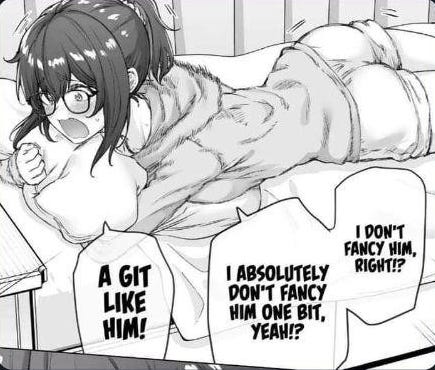
Pic related, because yes the female lead introduced early in the story becomes a romantic interest, and to De Zwarte Ridder’s credit said interest remains terms- and displays- of affection.
But for whatever reason this stood out to me:
“They’d landed atop what appeared to be one mostly disassembled, large container ship. Once a behemoth of the star lanes, this vessel was transformed into yet another makeshift living space. Lying on her beam, the craft had sprawled hundreds of homes, shopping centers, yet what dominated her cannibalized hull were storages. Big and small, these occupied the ship’s cavernous cargo bays. Split between owners with various persuasion, one could see a bunch of grav-trucks hauling a literal swarm of colorful boxes in and out. Of course, there was not a single CorpoSec patrol to be seen.”
I’ll end with this: You could imagine any kind of visual style for the above passage. Star Wars, Dune, Mass Effect, Blade Runner, The Expanse, Aliens, Dune, Homeworld, Halo, Metropolis… but whatever you imagine, the story still works. Going further: The Black Knight writes Crumbs in a way that’s agnostic of how you would imagine his world, and does not fuss over visually describing it. How you imagine the story looking will be different than how I imagined it.
Promoting QuestionablePenmanship
And who am I?
When I’m not getting in fights with strangers online, I write Swords of Sidonis. Let’s say, after Lord of the Rings or Game of Thrones or The Last Kingdom you find a good pallet cleanser in Gears of War, Doom, or Farscape, then you might like my admittedly verbose prose. If your tastes point you to something that is not definitively in one genre or the other, where perhaps the lines of technology and magic are more a gradient than opposing forces, give this a try.
DREAD Reviews Table of Contents (Searchable)
DREAD 62 | DREAD 63 | DREAD 64 | 🎃DREAD 65🎃 | DREAD 66
Participate (Self-promote) HERE
💰Paid a writer? Nominate one of their works for DREAD Reviews HERE💰
Bellageist and DREAD Reviews are reader-supported publications.
Please like & subscribe!
Consider clicking the button below and leaving a tip
"This is the first but not last time in fourteen chapters that speaking a surname would save someone’s life."
You’re one hell of a smart guy… lol. Thanks, man.
Happy that you were happy reading it :D