

DREADvice 1 » DREADvice 2
Welcome to the tiny, overconfident sibling of DREAD Reviews.
I’m Derek James Kritzberg. After 62 issues of meta-satirical demolition work, torturing 644 pieces on the page, reading up to five times that many that never received their deserved roasting, and somehow producing 442,000+ words of distracted nonsense in the process — I have something to say:
…I am still uniquely unqualified to give writing advice.
But I’m doing it anyway.
I know, I know — those of you who follow me on Substack notes may have seen an announcement downgrading the release of DREAD Reviews from every 2 weeks to every 3 weeks so I can focus on my book Bellageist: Chained Demigod.
So why am I launching a newsletter? It doesn’t make any sense, you say!
You’re right!
Each issue of this mini newsletter will tackle one small craft problem. It will be stared at until something resembling an opinion falls out. This opinion will be biased by personal taste and warped by whatever I happen to be reading that week. And possibly also incomplete.
This advice column should not be considered a commandment. Cult behavior is permitted — encouraged, even — but ultimately, the design of this newsletter is to SHAMELESSLY BAIT. These opinions will be delivered so we can argue about them.
Any jokes or satire that occur will be purely incidental. In a rare moment of clarity, I’ve dedicated myself to keeping things tight, getting to the point, and hopefully sparking a discussion which outgrows the kindling.
One topic, one issue, then comments. So, comment, please. In a desire to be efficient, I hope that you will do all the work. Haha! Please?
Oh, and subscribe if you enjoy watching someone with a mountain of receipts still have no idea what he’s talking about.
On we go.
Gods Aren’t People
Do you have one or more divinities in your fiction? I have a question for you.
If you strip away EVERYTHING about your god (or goddess) that makes your divinity a “person”, how much is left?
If your answer is “Most of it” or “A lot”, congratulations — you’ve written an extremely interesting, inspiring supernatural entity!
For those of you who look at your pantheon or omnipotent, comet-wielding dude or dudette and find that, once stripped of personality, banter, grudges, romantic subplots, or their tragic origin explaining why they throw lightning at mountains on Tuesdays… there is little to nothing left…
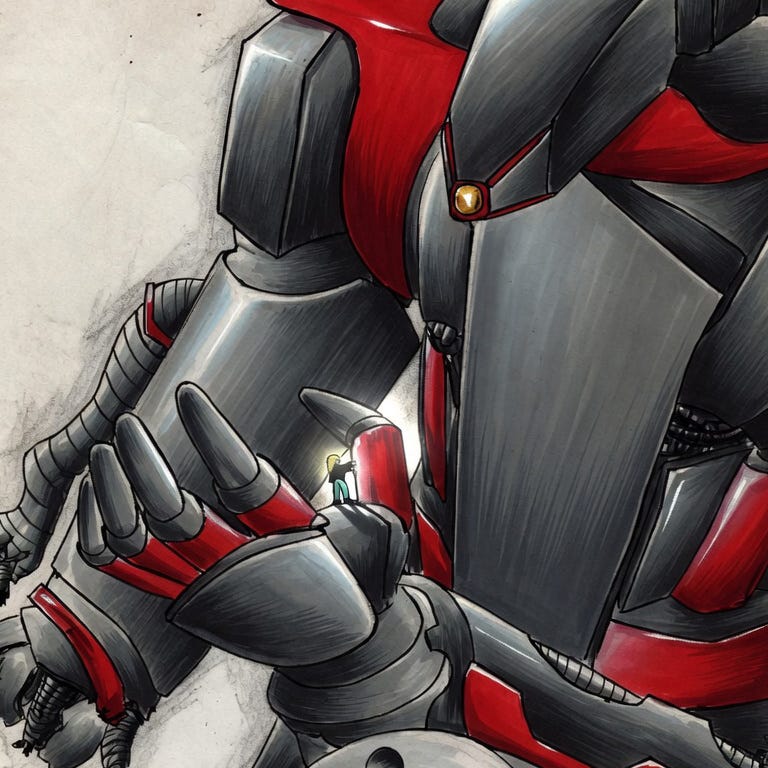
You have written a very powerful person enjoying better lighting. You have written a character. You have anthropomorphized, and therefore limited, something that should feel alien, unknowable, and terrifying (or, if it’s “benevolent”, then slightly terrifying).
It is not a crime if your divinity doesn’t pass the human-suit strip test. Gods as characters are good. Readers like characters. Just look at the Greek pantheon — it’s a drama club that’s inspired almost four millennia of writers. It’s a perfectly respectable playground. We enjoy the anthropomorphization of concepts to make them relatable. I am a HFY guy myself.
But let’s be real — a god who evaporates when you remove the person-suit is not a divinity. It is a raid boss with a big health bar. A middle manager between humans and the elements. A grumpy guide, a meddlesome harlot, a murderous psychopath.
What remains after you strip the “person” is the litmus test for a truly divine presence in fiction. A god should operate on a scale that cannot, or will not, stop when mortals fail to understand it. It follows rules that were not written for mortals. It is a presence that rearranges the room before anyone speaks, or even knows they have been granted an audience. It is an intelligence so vast it does not fit into any category measurable by a human-designed test. It may not be intelligence at all — it might simply be a force of nature on an unfathomable mission.
Fire does not “want” to burn. Fire simply burns.
Gravity does not walk into the room. It’s always there.
Direct contact with a divinity should be transformative, potentially damaging. It is not a scheduled meeting.
If a god can sit down and explain its five-year plan in plain speech, it is operating at human scale, not divine scale.
A silent god, a god that refuses, is a powerful god. A god is not a receptionist at a help desk.
Personality, family drama, heresies, hierarchies, and cultural textures should be traces a forceful god leaves imprinted on their world. They should be scar tissue, not a god’s core.
Finally, a god that starves without worship and actively seeks it is just a desperate salesperson. Belief as fuel is most interesting when it’s impersonal — a star doesn’t beg for more hydrogen — but it will devour what comes within reach.
If something like the above remains after your “human aspect” strip-down, you’ve put something truly fascinating on the page. I want you to tell me about it and link your relevant work in the comments!
If your god doesn’t pass this test, you’ve got a guy, or a gal, or something else. A cool guy or gal or something, and likely one I still want to read about. But still just a person. Feel free to prove to me in the comments why they’re still so good (I’m not hard to convince, so don’t hesitate to fight me about it).
Even better, show me something about divinity I haven’t thought of. Prove to me you know more about this than I do!
Thanks for reading.
DREADvice 1 » DREADvice 2
"A middle manager between humans and the elements. " - that's an angel/daemon/spirit and they can be interesting too.
It's definitely interesting from a philosophical point... I'd say the word "God" is part of the problem. I'm by no means a practicing Christian but I do think they have a clever enough work around in that Jesus and angels work as a subjective point of reference but "God" and the Holy Spirit are utterly abstract unknowable entities.
I think most cultures had those levels - the Egyptians had "Maat" as an abstract, mutable all-knowing force.
If Thor liked a good fight, and Loki was a sneak then Jörmungandr was utterly alien - I'd say Odin was pretty strange as well, and not very human in his behaviour.
If Zeus and Hera were having domestics then Chronos was unknowable - and of course we have HR Giger's alien as proof that nothing is more frightening than what can't be understood.
I'd say you can get away with divine "people" but you need the unknowable level of a full "God" behind...
Great piece.
Derek, my friend. Go to hell! Or possibly heaven. Or purgatory or limbo or wherever master baiters go. 🙄
Seriously, you are both right and wrong in so many ways in this article that I barely know where to begin. I could—and may have to—write an article refuting or agreeing with each individual statement.
Let's start with: "A god that starves without worship and actively seeks it is just a desperate salesperson." I call bullshit! Some great gods have been written that fade as their worship declines. A god sustained by belief can embody the reciprocal relationship between humanity and divinity: the god shapes its worshippers, but the worshippers also create and shape the god. Dependence doesn’t automatically make it less divine!
And I'd argue that your “human-suit strip test” is rhetorically very clever but logically rigged. It assumes from the outset that personhood is merely a suit covering the real divinity -- which is the very thing you’re supposed to be proving here. If you remove personality, desires, relationships, history, and psychology from *any* personal being, of course you may find little left except capabilities and function. You've also stopped writing a story and started writing a checklist. EPIC FAIL.
Let's say you strip all the personhood from Hamlet -- one of the most human "humans" in all of literature -- then all you’re left with is an unemployed Danish prince and several corpses. That does NOT prove Hamlet was never a person. All it proves is that personhood was the substance being examined. And gods can be a particularly powerful way to explore personhood and what it means to be “human,” precisely because they *aren't* human.
I could go on -- and I'm sure you'd just love that, ya troll -- but I'm supposed to be working right now.
Damn you...